
Case study · Trial qualification
Qualifying free-trial users in Clay before they reach sales
A client had more free-trial signups than its sales team could work. We built a Clay workflow around one high-intent moment, a trial-extension request, and turned it into a short list of qualified users sales could act on.
Built for: A software company with a free trial (client anonymized)
- 20 hrsRep research saved per week
- +25%Sales-assisted conversion
- +50%More qualified opportunities
01 · The situation
What needed to change
Signups were plentiful, but reps couldn't tell which users deserved a conversation, so they spent hours researching accounts by hand.
Many users signed up through GitHub without a company email, and some were competitors. Neither should reach an SDR unchecked.
02 · What we built
The workflow, step by step
- 01
Trigger on intent
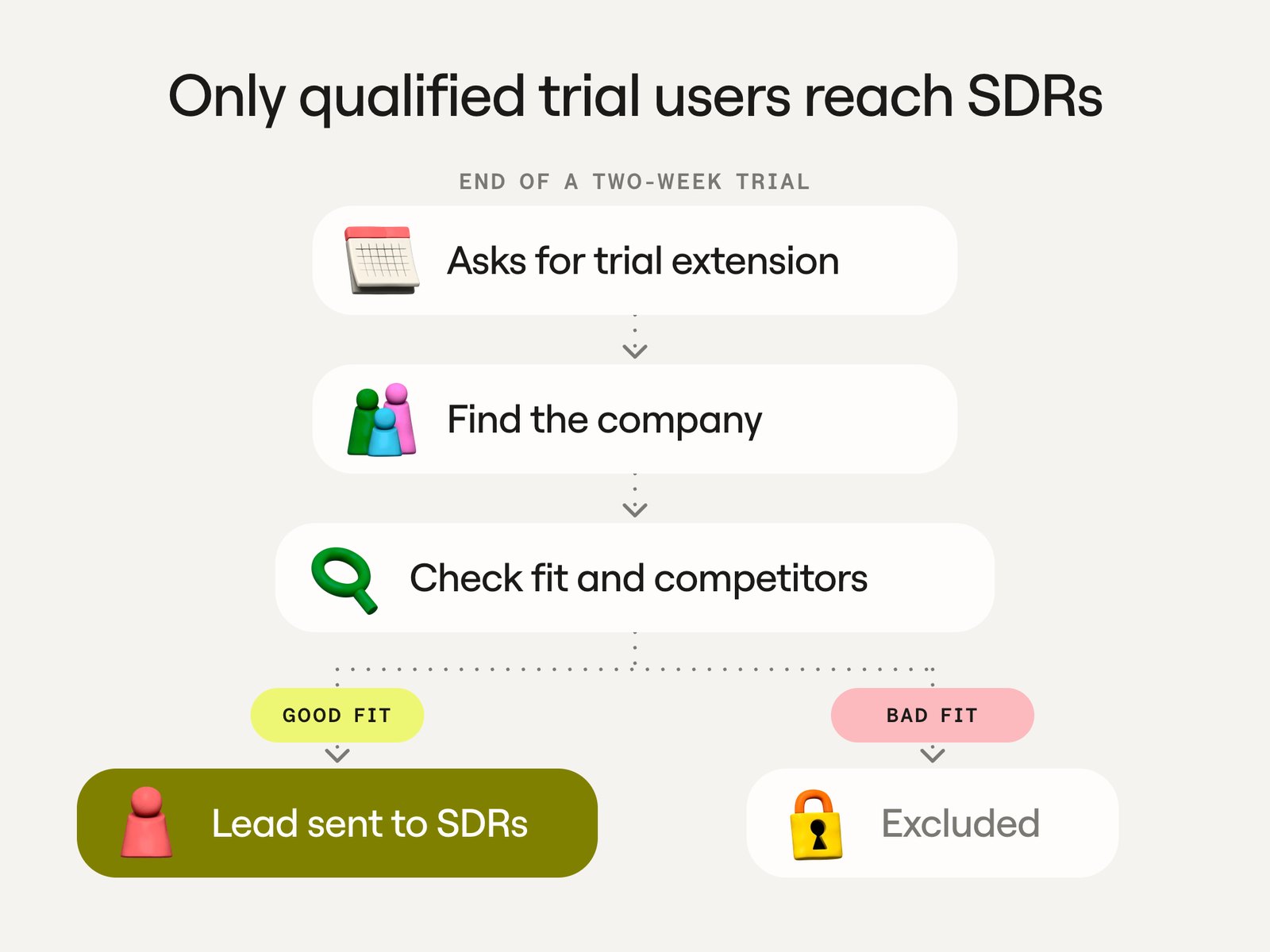
The workflow starts when a user reaches the end of a two-week trial and asks for another week. That request is a stronger signal than a signup.
- 02
Resolve the company
For users without a work email, the workflow works out which company they belong to, so qualification runs on the account, not just the person.
- 03
Apply the client's rules
Fit criteria come from the client's sales team. The workflow checks company fit and flags and excludes competitors before anything moves on.
- 04
Route with context
Qualified users go to SDRs in the place they asked for, with the company context reps said they needed to decide whether to engage.
- 05
Feed results back
Feedback built into the process shows whether routed leads become real pipeline, so the team can tighten or relax the rules over time.
03 · The result
What changed
Reps got back about 20 hours a week of research time, sales-assisted conversion rose 25%, and the workflow delivered 50% more qualified opportunities.
Sales still owns the decision. The workflow just makes sure the users in front of them are worth the time.
“An extension request tells us someone is still interested. Clay helps us add the company context and qualification so sales can decide whether to engage.” — Josh Whitfield
04 · Your build
What to decide before building one
- Pick one product event that shows real intent. A single strong trigger beats a scoring model built on ten weak ones.
- Agree on who is not a fit, including competitors, before you agree on who is.
- Decide where reps want the lead to appear and what they need to see, then build the output to match.
Want a workflow like this in your Clay workspace?
Josh and Jacob Whitfield scope Clay builds on a short call. Bring the process you want to fix.
Figures from the detailed trial-qualification section of Clay's published customer story about CMM (use case 02). Clay's summary at the top of that page lists a different conversion figure; we report the detailed one. The client is not named on this page. View CMM's Clay partner profile.