250 interested replies. 60 meetings. 3 days. Here's the whole stack.
Which systems powered CMM’s always-on outbound campaign?
CMM combined audience selection, lead verification, per-lead copy, sending limits, reply handling and pre-call research. The campaign produced about 250 interested replies in three days.
In this article
- MOST TEAMS THINK OUTBOUND IS A LIST PLUS A TEMPLATE
- THE CAMPAIGN WAS SIX SYSTEMS AGREEING
- EVERY EMAIL IS ABOUT THEIR CUSTOMERS, NOT YOU
- WHAT IT ACTUALLY COSTS
- INTERESTED HAS A HALF-LIFE
- SHOW THEM THE SYSTEM BEFORE THE CALL
- THE SYSTEM: THE ALWAYS-ON PVP STACK
- 1/ Define the ICP by tool usage, not firmographics
- 2/ Source from where your buyers already gather
- 3/ Qualify company fit with rules first, a rubric second, a human last
- 4/ Verify like your domains depend on it
- 5/ Write PVP copy per lead, then grade it with something that didn't write it
- 6/ Load always-on and run at cap
- 7/ Treat every interested reply like a fire drill
- 8/ Build the proof before the call
- THE MISTAKES THAT TAUGHT ME THIS
- THIS WEEK
Claude builds, Clay audiences, OpenRouter, Parallel, per-lead PVP copy, a crew of Grok Bots on the replies, and a proof pack before every call. Nothing held back.
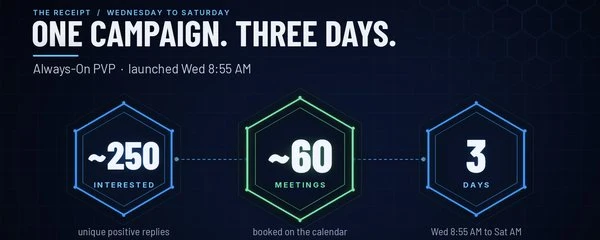
On Wednesday at 8:55 AM we turned on one always-on campaign.
By Saturday morning it had about 250 interested replies and about 60 meetings.
The careful version: Instantly shows 250+ opportunities (unique people with a positive status) and 53 meetings booked straight from the campaign. My discovery calendar shows 75 calls created since Wednesday. About 111,000 emails sent. 4 bounces.
People are going to ask me for the subject line.
There isn't one. There are 110 different ones in a 129-lead sample.
This is the full build. The stack, the actual emails, what it cost, the bots that work the replies, and the pack we build before every call. Steal all of it.
MOST TEAMS THINK OUTBOUND IS A LIST PLUS A TEMPLATE
They buy a list.
They write one email.
They A/B two subject lines.
They call that a campaign.
Then they're shocked when 0.07% of the people they contact become opportunities.
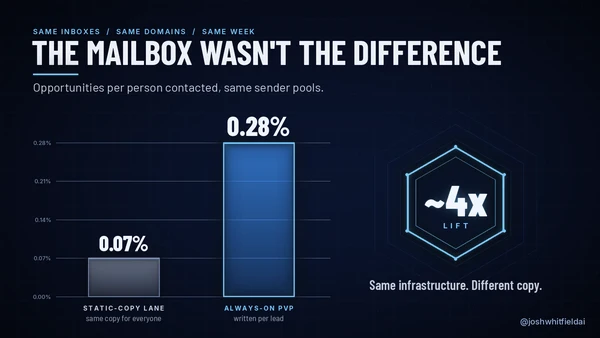
I know that number because it's ours. Our static-copy lane, running on the same sender pools as this campaign, did about 0.07% opportunities per person contacted. The new campaign did about 0.28%.
Same inboxes. Same domains. Same week. Roughly 4x.
The mailbox was not the difference. The stack behind each email was.
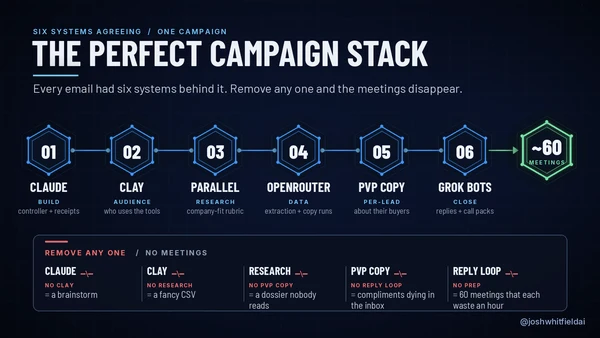
THE CAMPAIGN WAS SIX SYSTEMS AGREEING
Here's what had to fire before a stranger replied "all of them" and booked a call.
Claude built it. Not "write me an email." Claude Code was the build controller: the ICP cuts, the audience logic, the verification waterfall, the copy contract, the loader, the release gates. Every change lands as a commit with a receipt. If I can't rebuild the campaign from the receipt, it isn't done.
Clay held the audience. We didn't start from a filter. We started from who already uses the tools. People who follow the company pages of the sending and data tools GTM teams live in, plus Clay people search and partner directories. Every lead carries two tags: a segment (lead gen agency, B2B SaaS, marketing agency, GTM engineering agency) and the tool they likely run. The build lane behind it runs six finder lanes in parallel at roughly 900 to 1,000 verified per hour, and an hourly loader tops up in 250-row batches, reading every batch back to confirm it actually landed.
Parallel is the research layer. Since Oct 27 our default company-fit check is rules first, then a Parallel Decisions rubric. Anything under 0.65 confidence goes to a human. On a 100-company spot check: 85 right, 7 wrong, 8 held for review.
OpenRouter is the data layer. On Oct 26 Claygent ran out of credits at 7 AM and a copy run died mid-workflow. We moved the heavy LLM steps inside Clay onto OpenRouter (a cheap flash model through an HTTP node) that afternoon. Extraction and copy kept moving on our own key.
To be precise: those are layers of the whole engine. I'm not claiming Parallel or OpenRouter scored each of these specific leads. I'm telling you what the system underneath looks like.
PVP copy wrote the email. Per lead. Not a template with a first name glued on. Subject, body and P.S. are all variables written for that person.
Grok Bots and two humans closed the loop. Interested reply in, calendar out, same day. Then a qualification pack built before the call.
Remove any one of those and the meetings don't show up.
Claude without Clay is a brainstorm.
Clay without research is a fancy CSV.
Research without PVP copy is a dossier nobody reads.
PVP copy without a reply loop is a pile of compliments dying in the inbox.
A reply loop without prep is 60 meetings that each waste an hour.
EVERY EMAIL IS ABOUT THEIR CUSTOMERS, NOT YOU
This is the part people actually want, so here are the real emails. Company names stripped, structure untouched.
The idea is "permissionless value." Step 1 doesn't describe our product. It describes the public moments the prospect's own buyers go through right before they need the prospect. Then one line on how we'd catch those moments. Then one soft question. Then a P.S. that hands over a free, specific place to look.
Example 1. Sent to the CEO of an appraisal firm. He booked a call.
Subject: the document before the order
Hi {{firstName}}...
An appraisal order usually follows a document someone else filed: a probate petition opening an estate, a divorce filing with asset schedules attached, a charitable gift of property over $5,000 that needs a Form 8283 before the return goes out, or a lender's equipment schedule ahead of a closing.
Those filings are public on county court dockets before anyone starts searching for an appraiser. Our engine watches dockets, court records, press releases, job boards and 50+ other live sources. When one fires, the account enters a sequence that day, with the email built around that filing.
Where does most of your work originate?
P.S. County probate court dockets and registers of wills publish new estate appointments, naming the personal representative who has to file the date-of-death inventory.
His reply opened with "Nice email, this caught my attn." Then he told us they're mostly inbound. Then he booked anyway.
Example 2. Sent to a RevOps director at a hardware security company. Booked.
Subject: gpu fleets and new cisos
Hi {{firstName}}...
A neocloud doesn't publish a security RFP when it stands up a new GPU cluster. It publishes the capacity announcement, posts the platform and data center engineering roles, and files the funding. The security leader who owns firmware sign-off usually arrives a few weeks ahead of the first tenant.
Our engine watches those moments continuously across 50+ live sources, including press releases, job boards, SEC filings and LinkedIn moves. When one fires, the account enters a sequence that day with the opener built around that event.
Which tends to come first for you: a GPU fleet going live, or the new CISO who inherits the audit?
P.S. Utility interconnection queues and county permitting portals list new data center capacity while it's still being planned. Search the operator's name and the megawatt request.
His reply started with "Dang it. I pride myself in screening cold emails..."
Example 3. Sent to a GTM engineer at a RevOps consultancy.
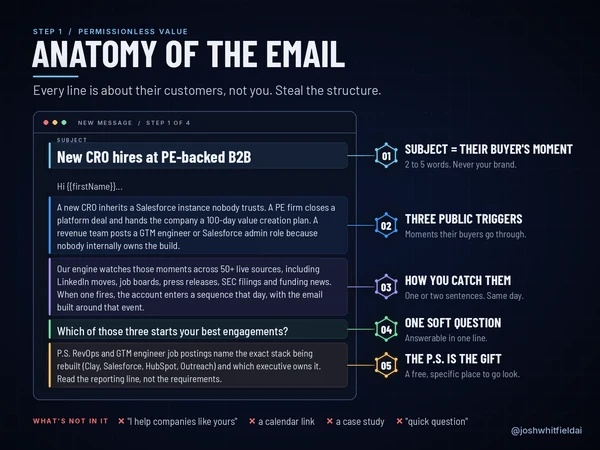
Subject: New CRO hires at PE-backed B2B
Hi {{firstName}}...
A new CRO inherits a Salesforce instance nobody trusts. A PE firm closes a platform deal and hands the company a 100-day value creation plan. A revenue team posts a GTM engineer or Salesforce admin role because nobody internally owns the build. In each case the foundation problem is live well before anyone starts looking for help.
Our engine watches those moments across 50+ live sources, including LinkedIn moves, job boards, press releases, SEC filings and funding news. When one fires, the account enters a sequence that day, with the email built around that event.
Which of those three starts your best engagements?
P.S. RevOps and GTM engineer job postings name the exact stack being rebuilt (Clay, Salesforce, HubSpot, Outreach) and which executive owns it. Read the reporting line, not the requirements.
Step 2 is a worked example of one signal. Same thread, two days later, no new subject:
Hi {{firstName}}...
Take the CRO signal. A new CRO starts Monday at a PE-backed B2B company and the move shows on LinkedIn that morning. Same day, the engine pulls the stack they're inheriting from job posts and tech data, flags an acquisition that left two CRMs, and the opener names that handover instead of pitching.
Do first-90-day CROs turn into engagements for you, or stay conversations?
Look at what's not in any of these.
No "I help companies like yours."
No calendar link.
No case study.
No "quick question."
Step 3 is the only place I talk about me (one credential paragraph and a soft "worth 20 minutes?"). Step 4 is the breakup, and it's the only step with a calendar link.
The anatomy, so you can copy it:
Subject: 2 to 5 words naming their buyer's moment. Never your brand.
Paragraph 1: three public trigger moments their buyers go through.
Paragraph 2: one or two sentences on how you'd catch those moments that day.
Question: "Which of those three..." or an either/or. Easy to answer in one line.
P.S.: a free, specific source they can go check themselves. That's the gift.
The replies told us it worked before the numbers did. "Best cold outreach email I've ever gotten." "All of them." "What do you charge." One person replied asking if it was a template with variables. Technically yes. It's just that every variable is the whole email.
WHAT IT ACTUALLY COSTS
Everyone skips this section. Here's ours, from the receipts.
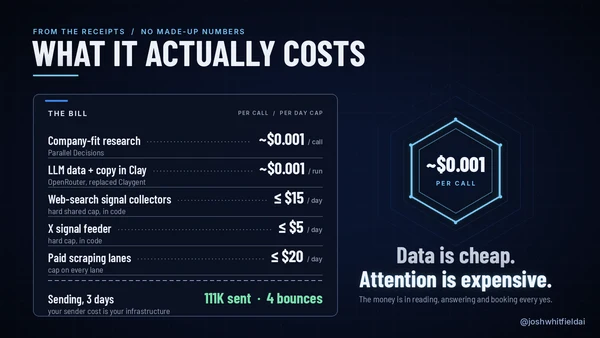
Company-fit research (Parallel Decisions): about $0.001 per call. Rules run first, so most companies never need a call at all.
LLM data and copy work inside Clay (OpenRouter): the run that replaced Claygent costs about $0.001 per weekly run.
Web-search signal collectors: search plus a flash model through OpenRouter for extraction, under a hard $15/day shared cap. The X signal feeder has a $5/day cap. Every paid scraping lane has a $20/day cap. Caps live in code, not in someone's head.
Clay: people and company searches in query mode, which doesn't spend work-email credits. We stopped leaning on Clay credits for LLM steps after the Oct 26 outage, because a near-zero balance kills a workflow at 7 AM.
Finding and verifying: this is where real money goes, so we gate it. Suppression against the whole sending workspace runs before any paid lookup. Then a primary verifier, and a second verifier only on catch-alls.
Sending: about 111,000 emails in three days through Instantly, ramping 20,000 Wednesday → 45,289 Thursday → 45,674 Friday, which is our daily cap on shared sender pools. 4 bounces. That's about 0.004%. I'm not going to make up a per-email number for you. Your sender cost is your infrastructure.
Here's the honest frame. Data is cheap. Attention is expensive.
The research layer costs fractions of a cent. The expensive part of this whole system is what happens after someone says yes: reading every reply, answering it like a human, and getting a call on the calendar before the thread goes cold. That's why we built bots for it.
INTERESTED HAS A HALF-LIFE
When 250 people say yes in three days, the bottleneck moves. It's no longer the list or the copy. It's the inbox.
So we set up a small crew of Grok Bots to run the reply side with the humans.
The Instantly Reply Monitor. It checks every managed Instantly workspace (20 live right now) every 15 minutes. It's conservative on purpose: auto-replies, out-of-office, unsubscribes and "not interested" get rejected, and an unlabeled reply only counts if it shows clear positive intent in a short message. It only wakes anyone when there's a new hit. No polling, no noise.
The Email and Slack BOT. When an interested reply lands, it shows up in a Slack channel and the bot drafts the response, so a human is editing, not starting from a blank box.
Two humans who book. Standing order since Thursday morning: two people on my team book interested replies onto the calendar as fast as possible, and they split calls when my calendar fills. Booking is the top priority, above everything else that day.
The result on day one: median time from first reply to a booked call was about 33 minutes (11 bookings, range 10 minutes to about 4.6 hours). One person booked 3 minutes after step 1 landed without replying at all.
And we audited day one so we wouldn't fool ourselves. All 37 positive leads earned their status after step 1 went out. Zero pre-tagged. All 12 meetings matched a real calendar booking.
It also showed us about 14% of the positives were weak (a compliment only, a "not now," one counter-pitch). Count your scoreboard honestly or you'll scale a fantasy.
SHOW THEM THE SYSTEM BEFORE THE CALL
Here's the move I think most agencies miss.
When someone books, we don't show up with a deck. We show up with their campaign already built.
The Pre Call BOT builds a day-before qualification pack for every booked discovery call:
One workbook. Nothing else to open.
At least 100 verified, clear leads in their market, for their buyers.
ICPs and personas for their business, built in Octave.
Three PVP copy variants written in the same framework as the emails above, in their voice.
Review only. Nothing uploaded, nothing sent.
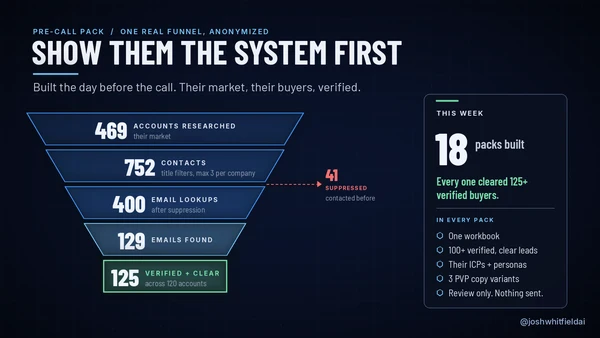
Here's one real pack funnel, anonymized. A founder replied to a PVP email and asked three things on the booking form: how accurate the signal source is, what implementation looks like, and whether we had data for his niche. The pack was scoped to answer exactly those.
469 accounts researched
752 contacts after title filters, max 3 per company
41 suppressed before lookup because they'd been contacted before
400 email lookups, 129 found
125 verified and clear across 120 accounts
Spend: 129 finder credits, 129 primary verifications, 24 second-verifier checks on catch-alls
18 packs this week. Every one cleared 125 verified buyers.
The prospect walks into the call and sees their own accounts, their own personas, and three emails they could send Monday. The conversation stops being "can you do this?" It becomes "when can this go live?"
THE SYSTEM: THE ALWAYS-ON PVP STACK
The whole thing as a checklist. Run it on Clay plus any sequencer.
1/ Define the ICP by tool usage, not firmographics
Pick 3 to 4 segments and tag every lead with segment + likely tool
Pass: you can say why each lead is on the list in one line. Fail: "they're B2B, 50 to 500 employees."
2/ Source from where your buyers already gather
Followers of the tool pages they use, people search, partner directories. Max 3 contacts per company
Pass: suppression against your whole sending workspace runs before any paid lookup. Fail: you pay to verify people already in a campaign.
3/ Qualify company fit with rules first, a rubric second, a human last
Fixed rules, then a scored rubric with a 0.65 confidence floor. Under the floor goes to review
Pass: a 100-company spot check is right 85%+ of the time. Fail: nobody has ever spot-checked the qualifier.
4/ Verify like your domains depend on it
Primary verifier; catch-alls go to a second verifier, and only "deliverable" counts
Pass: bounces under 0.1% (we ran 4 on 111K). Fail: you find out from your inbox health dashboard.
5/ Write PVP copy per lead, then grade it with something that didn't write it
Subject = their buyer's moment. Three triggers. One question. Free signal in the P.S. Body under 165 words. Calendar link only in the last step
Pass: an independent grader scores every email and some fail. Fail: every message grades 7 out of 7. If that happens, your grader is inflating.
6/ Load always-on and run at cap
Hourly top-ups with read-back, so a lead counts only when the sequencer actually created it
Pass: the campaign never runs dry mid-day. Fail: "the list ran out Thursday."
7/ Treat every interested reply like a fire drill
Monitor every 15 minutes, wake a human only on new hits, draft the reply, book the same day, split owners when one calendar is full
Pass: median reply to booked under 60 minutes (ours was about 33). Fail: "we'll get back to them Monday."
8/ Build the proof before the call
Day-before pack: 100+ verified leads in their market, their ICPs, 3 copy variants. Size it from your find rate, so research 750+ contacts to clear 100
Pass: the prospect sees their own campaign on the call. Fail: you're presenting a deck about yourself.
THE MISTAKES THAT TAUGHT ME THIS
We wrote the rulebook after it worked. The independent grader, the 7 standards, the 165-word cap and the "7 out of 7 means you're inflating" rule were all written down the evening after day one, once the campaign was already winning. The campaign taught the rulebook, not the other way around. Rule: write the standard down the day it works, or your next build drifts back to average.
Our reply monitor went quiet on day two. The supervisor process running it died the afternoon of day one, so the monitor missed a whole day of interested replies. It still undercounts today. The humans caught it because the calendar kept filling. Rule: the monitor is a wake-up call, not a ledger. Your calendar is the source of truth for booked meetings.
Our best email isn't step 1. Step 2 (the worked example) turns 30.2% of its replies positive. Step 1 turns 23.3%. Small sample on step 2 (96 replies), but it's the next rebuild. The concrete example beats the list of three.
And the one that matters most: the static lane on the same inboxes ran about 4x worse. Same infrastructure. Different copy.
The list wasn't the moat.
The email being about their customers was.
Complexity isn't the enemy of outbound. Unowned complexity is. If every layer (build, audience, research, data, copy, send, replies, prep) has an owner and a receipt, the stack compounds. If any layer runs on vibes, the meetings disappear and you blame the subject line.
THIS WEEK
Take 100 leads from your best segment.
Rewrite step 1 so the subject names their buyer's trigger moment, paragraph one lists three public moments their customers go through, and the P.S. gives away one specific place to look. Move the calendar link to the last step.
Then set one rule for the replies: every interested reply gets a human answer and a booking link within 60 minutes. Measure positive-reply % and reply-to-booked time against your current opener for 5 business days.
So I'm curious:
Is your first email about your product, or about the moment your prospect's buyer is in right now?
Article figures