Clay or Claude Code? We run both. Here's exactly where the line is.
When should a GTM team use Clay or Claude Code?
CMM uses Clay for repeatable checks, routing and paid enrichment. Claude Code handles open-ended research and returns the evidence to Clay for verification.
In this article
This week a lot of GTM people picked a side. Clay or Claude Code. Tables or terminals.
We never had to pick. Clay is the backbone of every build we run. Claude Code agents work around it: they go find what no database has yet, and what they find plugs back into Clay.
The split isn't about taste. It comes down to one question: does this step need to run the same way every time, or does it need to go find something nobody has written down yet?
Here's where we drew the line, with two real builds and their numbers.
By the end you'll know:
1. What we build in Clay, and why it sits at the core
2. Which research we hand to AI agents, and how it plugs in
3. What broke when we wired them together, and the rule it gave us
4. A 6-step checklist to split your own stack
5 words you'll see
Gate: a check a record has to pass before the next step runs.
Review hold: where a record goes when it fails a gate. A person looks at it. Nothing gets sent.
Pre-call pack: a list of real buyers in a prospect's own market, built before our sales call so they see what we'd send for them.
Verified buyer: a named person with a dated public signal and an email that passed verification.
Catch-all: a domain that accepts every address, so a basic check can't tell you if the email is real.
1/ Clay is the backbone: anything that costs money or has to be repeatable
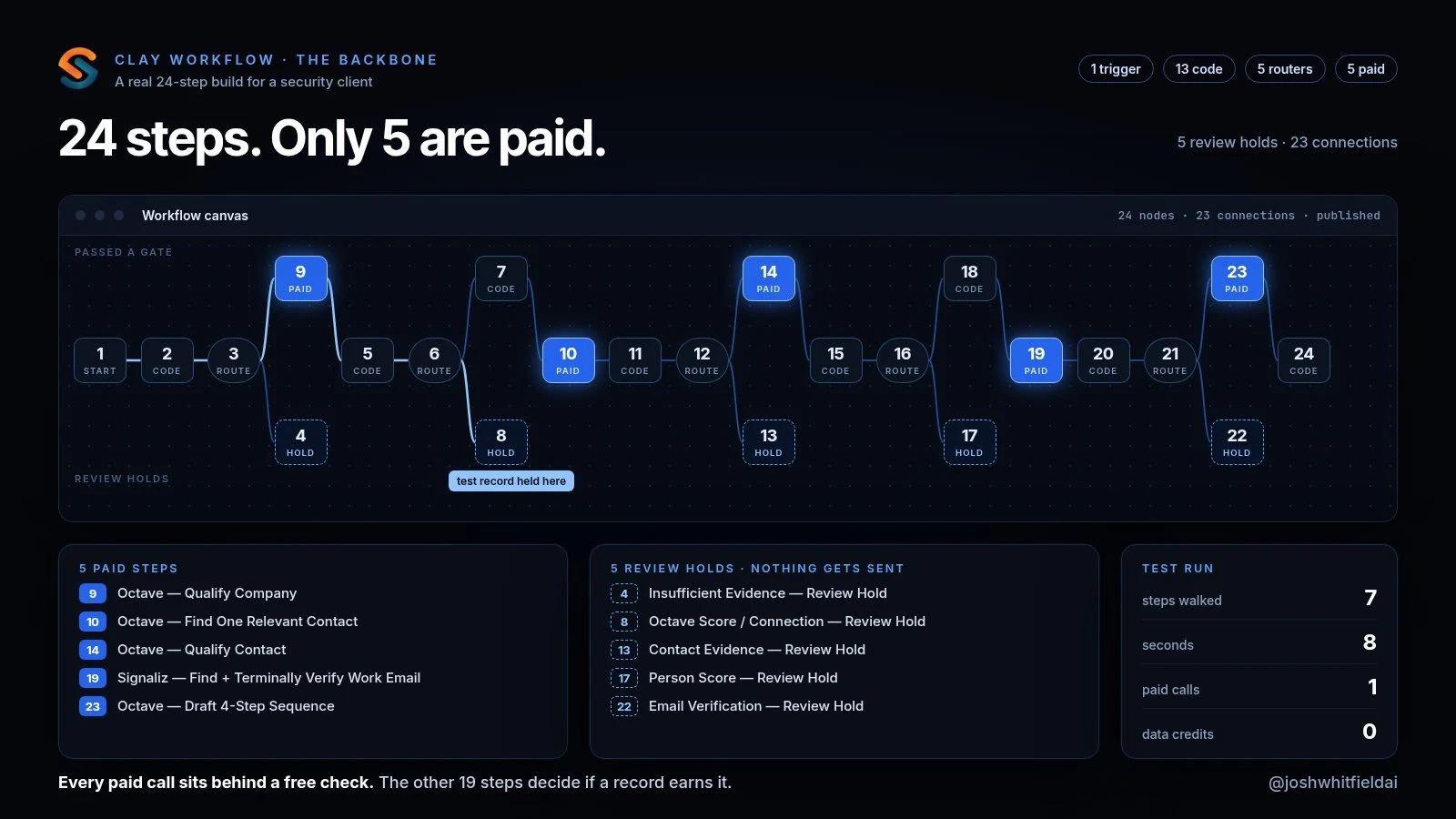
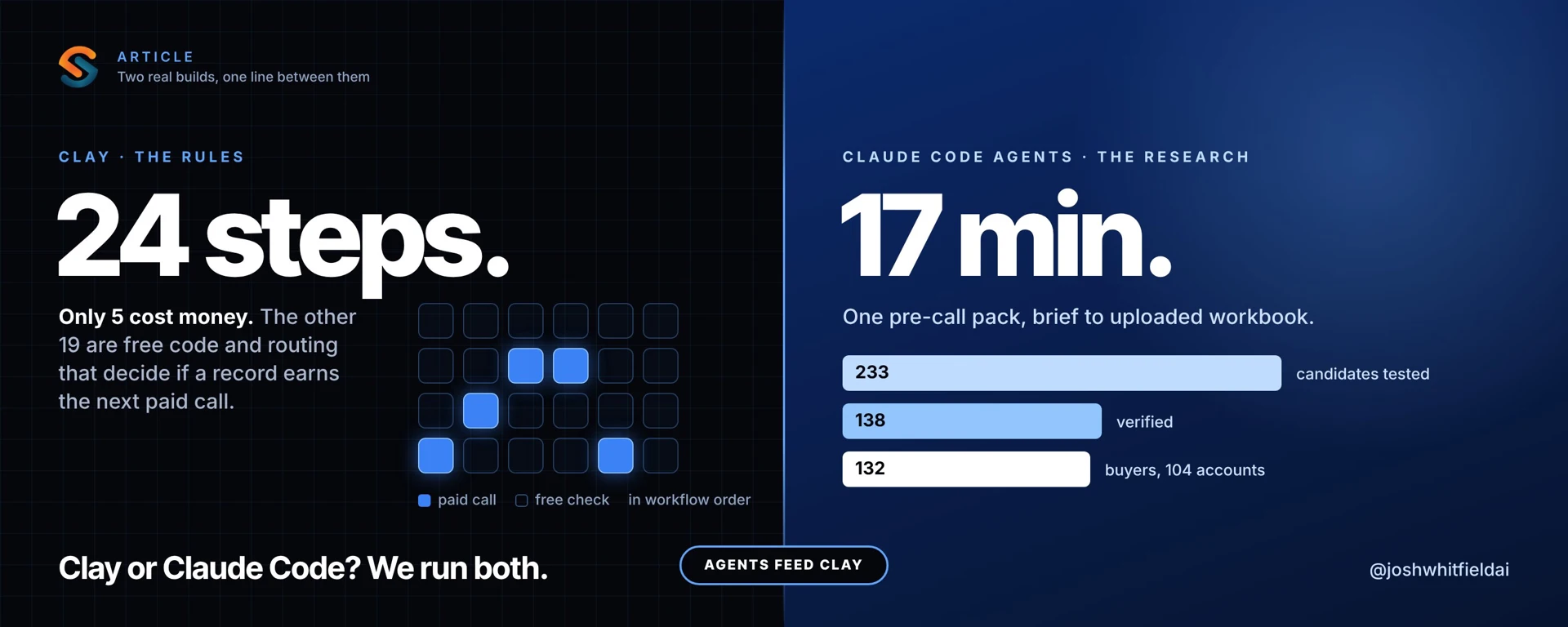
We built a Clay workflow for a security client. It has 24 steps: 1 trigger, 13 code steps, 5 routers and 5 paid tool calls, joined by 23 connections.
Only 5 of the 24 call paid tools. The other 19 are code and routing that decide whether a record has earned the next paid call. Records come in with signals from Common Room. The paid steps use Octave to score and draft, and Signaliz to find the email.
The order:
1. Preflight, free. Code checks what we already know before any AI runs. Outside the US or Canada? Under $250M revenue? Under 200 employees? Under 50 developers? No Git, no CI/CD, no public cloud? Any known no goes to a review hold. So does a record missing its basics, like a domain or an engagement score.
2. Company fit, paid step 9. The AI scores the company and it needs 7 out of 10. The score alone isn't enough. A code step right after it checks every criterion for its own evidence.
3. One contact, not ten, paid step 10. Find one relevant security or engineering leader. Then code checks first name, last name, title, LinkedIn URL and a company domain that matches. Miss any one and the record holds before the next paid call.
4. Person fit, paid step 14. The AI scores the person, 7 out of 10 again. Below 7, no email lookup.
5. The email, paid step 19. Find and verify one work email. It has to come back valid, safe to send and not catch-all.
6. A 4-step draft, paid step 23, for a human to review. The last step packages the company, the person, the email and the draft. It doesn't write to the CRM, post to Slack, export or send anything.
How we build it: every code step ends by writing one field, a route. The router after it reads only that field. No router makes a judgment call, so nothing drifts into a paid step because it looked close enough. Each of the 5 routers has its own review hold, so you can see exactly where a record stopped and why.
Why this lives in Clay: every record walks the same path, every paid call sits behind a free check, and every failure lands somewhere a person can see it.
The gate that earned its keep: in testing, the AI gave a company a 10/10 fit score. The gate held it anyway. 13 of its 14 checks passed. The one that failed was revenue. The summary said the company was "meeting all geographic, revenue, and size thresholds," but the revenue question was never actually answered.
So the gate ignores summaries. Each criterion needs its own yes. A rationale that says "likely," "probably," "typically" or "can be inferred" fails. We keep 21 hedge words on that list. Git evidence has to name GitHub, GitLab or Bitbucket. CI/CD has to name a real system, like Jenkins, GitHub Actions, CircleCI, GitLab CI or Azure DevOps. Cloud has to name AWS, Azure, GCP or Google Cloud.
That test record walked 7 steps in 8 seconds. It made 1 paid call, used 0 data credits and 1 action credit, and stopped at the hold before any contact or email spend.
Clay is also where our client campaigns start. Leads come from the Clay Audience cache and run through a Clay workflow that finds emails. Then MillionVerifier and BounceBan verify them. Another finder only comes in as a fallback if that workflow can't be reached.
Takeaway: put your rules where they can't be talked around. A model will write a confident summary. Code in Clay checks whether the answer is there.
2/ What agents do: the open-ended research that feeds Clay
Pre-call packs are a different kind of work. There's no clean database for "people at companies in this prospect's market who did something public in the last few weeks." Somebody has to go find them.
So agents do it. One coordinator bot writes the brief and a run script, then starts a Claude Code session per pack. Up to 5 packs build in parallel. Each session gets 400 web searches and a 150-minute time limit. If it's cut off short of the bar, it gets one resume. If it's still short, it gets one fix pass. Then it stops and reports.
Each pack has the same bar: 100 verified buyers.
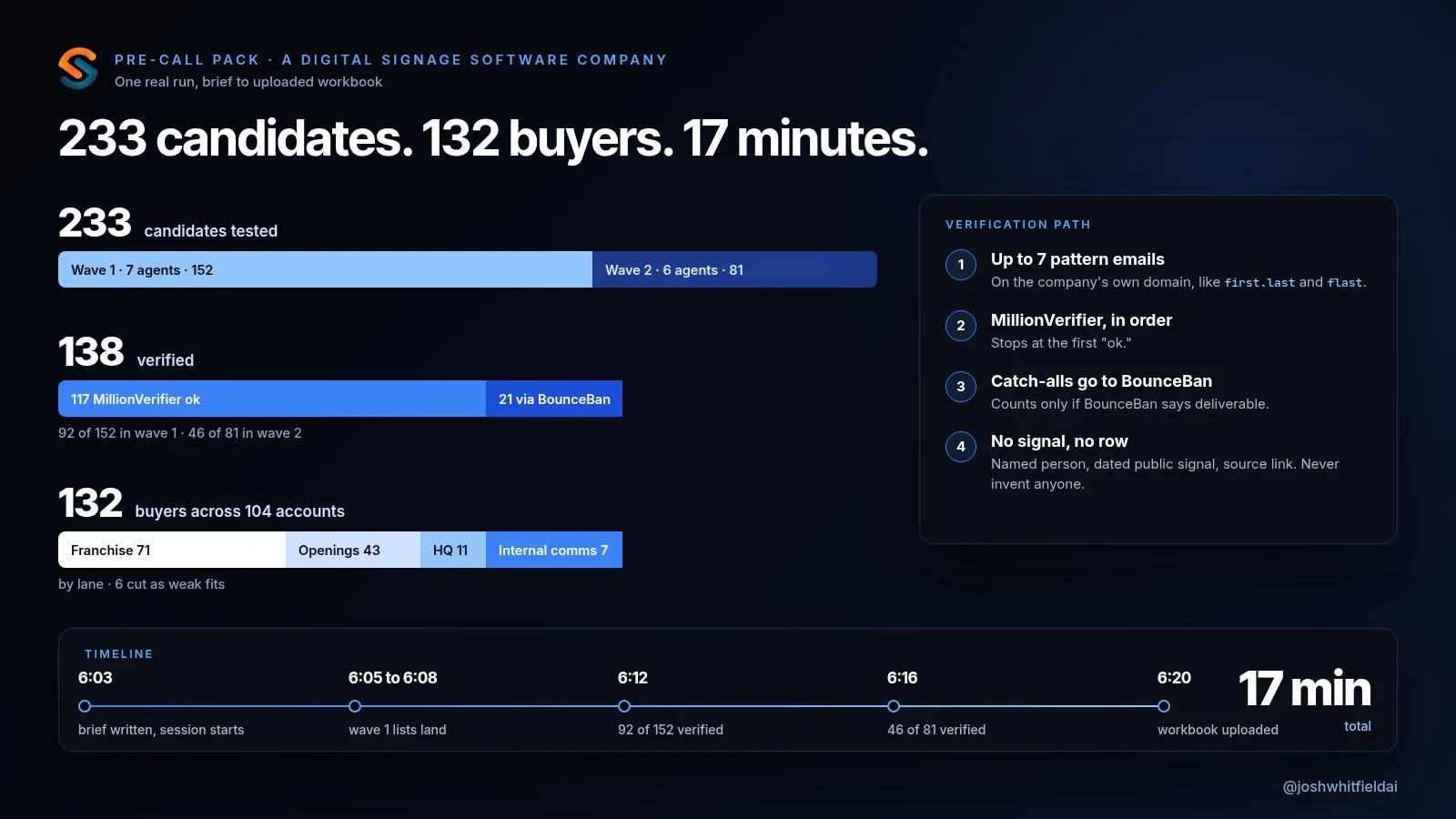
One real run, for a digital signage software company:
- 6:03 AM: the brief is written and the session starts.
- Claude splits the market into 4 lanes: franchise groups, new location openings, HQ teams, internal comms.
- 7 research agents run in parallel. Their lists land between 6:05 and 6:08. With duplicates removed, that's 152 candidates.
- Every candidate needs a named person with a public title, a dated public signal and a source link. Signals from June on are preferred, and nothing older than March counts. 1 to 3 buyers per account, max. No signal, no row. Never invent a person, title, date or URL.
- Each candidate gets up to 7 pattern emails on their company's domain, like first.last and flast. MillionVerifier checks them in order and stops at the first "ok." If a pattern comes back catch-all, it goes to BounceBan and only counts if BounceBan says deliverable.
- 6:12 AM: the first pass verifies 92 of 152.
- 6 more agents run a second wave to fill the thin lanes, skipping companies already found. One comes back empty. Together they add 81 candidates, and 46 verify by 6:16.
- 233 tested, 138 verified: 117 passed MillionVerifier outright and 21 were catch-alls BounceBan cleared. 6 cut as weak fits. 132 buyers across 104 accounts.
- 6:20 AM: workbook built and uploaded. 17 minutes total.
The lanes weren't even: franchise 71, openings 43, HQ 11, internal comms 7. The agent said so in its receipt. Internal comms was thin because searches mostly turned up job postings, not named hires. It also flagged that every email was pattern-guessed and verified by tools, not confirmed by a person, so spot-check before any send.
The workbook passes 6 QA rules before it ships, each from a mistake a pack already shipped: a name hardcoded in a template, a merge field inside a merge field, a placeholder where a link belongs, an internal file path, a note on how we found someone, and our question written as if the lead asked it. The agent checks all 6, and greps the workbook for known bad patterns, before it can say done. A separate check keeps tool names out of anything the prospect will see.
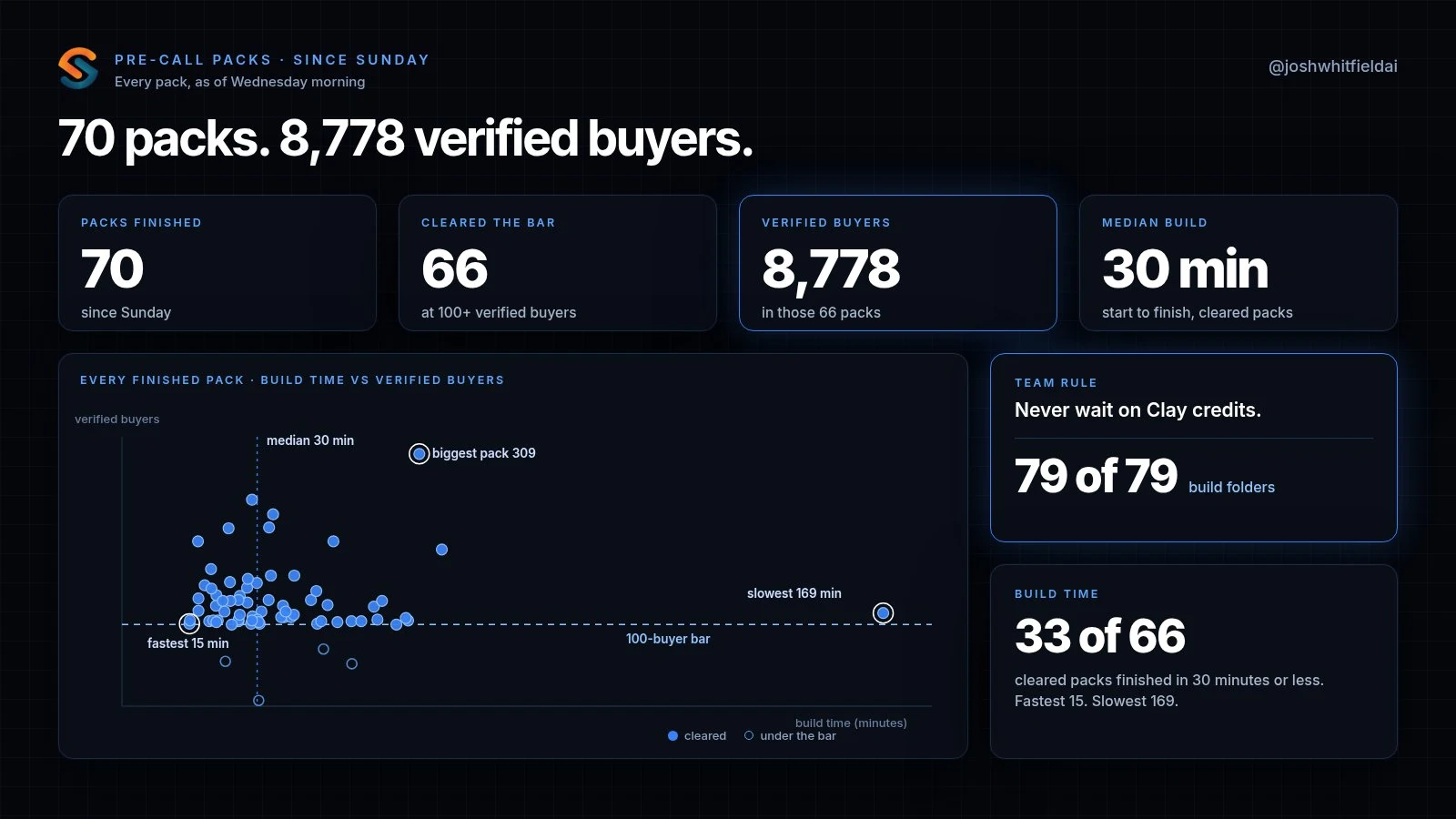
Across every pack since Sunday (as of Wednesday morning):
- 70 packs finished
- 66 cleared the 100-buyer bar
- 8,778 verified buyers in those 66
- Median build time: 30 minutes
Half the cleared packs, 33 of 66, finished in 30 minutes or less. The fastest took 15 minutes. The slowest took 169. The biggest pack held 309 buyers.
Here's how it plugs into Clay. A pack is a head start: the market, the signals and the copy angle, built for one call. It isn't the campaign. A client campaign runs to thousands of leads, and that list comes from Clay. In the handoff we're writing down now, every pack lead goes back in as a seed and has to pass the same Clay gates as a net-new lead.
Takeaway: agents are good at the part that used to be a researcher's afternoon. Give them a hard bar, a no-signal-no-row rule and a verifier they can't skip. Then hand what they find to Clay.
3/ What broke when we wired them together
Early on, our packs ran Clay's people search inside the agent's research loop. Then we hit the quota.
One pack failed three times before it passed:
- 60 buyers. Clay quota out, web search capped.
- 73. The last two agents added 1 person between them.
- 89. The quota was still out after the reset.
- 114. Done.
Packs were stalling while they waited for the quota reset at 5 PM our time. The problem wasn't Clay. It was where we'd put it: a quota-bound step in the middle of a loop that was supposed to keep searching. So mid-run on Sunday afternoon we wrote a team rule: never wait on Clay credits.
The rule says research the web first: team pages, press releases, trade news, speaker lists. Build pattern emails, verify, and ship the workbook once you hold 100. Clay people search is an optional top-up. All packs share one lock, so only one pack runs it at a time, and it stops at the first quota error.
The coordinator relays that rule into each build's instructions, and every build script tells the session to read it first. 79 of 79 build folders carried it as of this morning.
Takeaway: keep Clay at the core of the build, where it's strongest, and keep quota-bound calls out of the middle of an agent's research loop. Inside that loop, make them the top-up, not the path.
4/ Where agents still lose
One market was tiny owner-run businesses. They rarely have a personal mailbox on their own domain. About 1 in 5 candidates verified.
The pack stopped at 7 buyers and didn't build a workbook. That's the right answer. Some markets aren't a copy problem. They're a data problem, and no amount of agent time fixes a missing inbox.
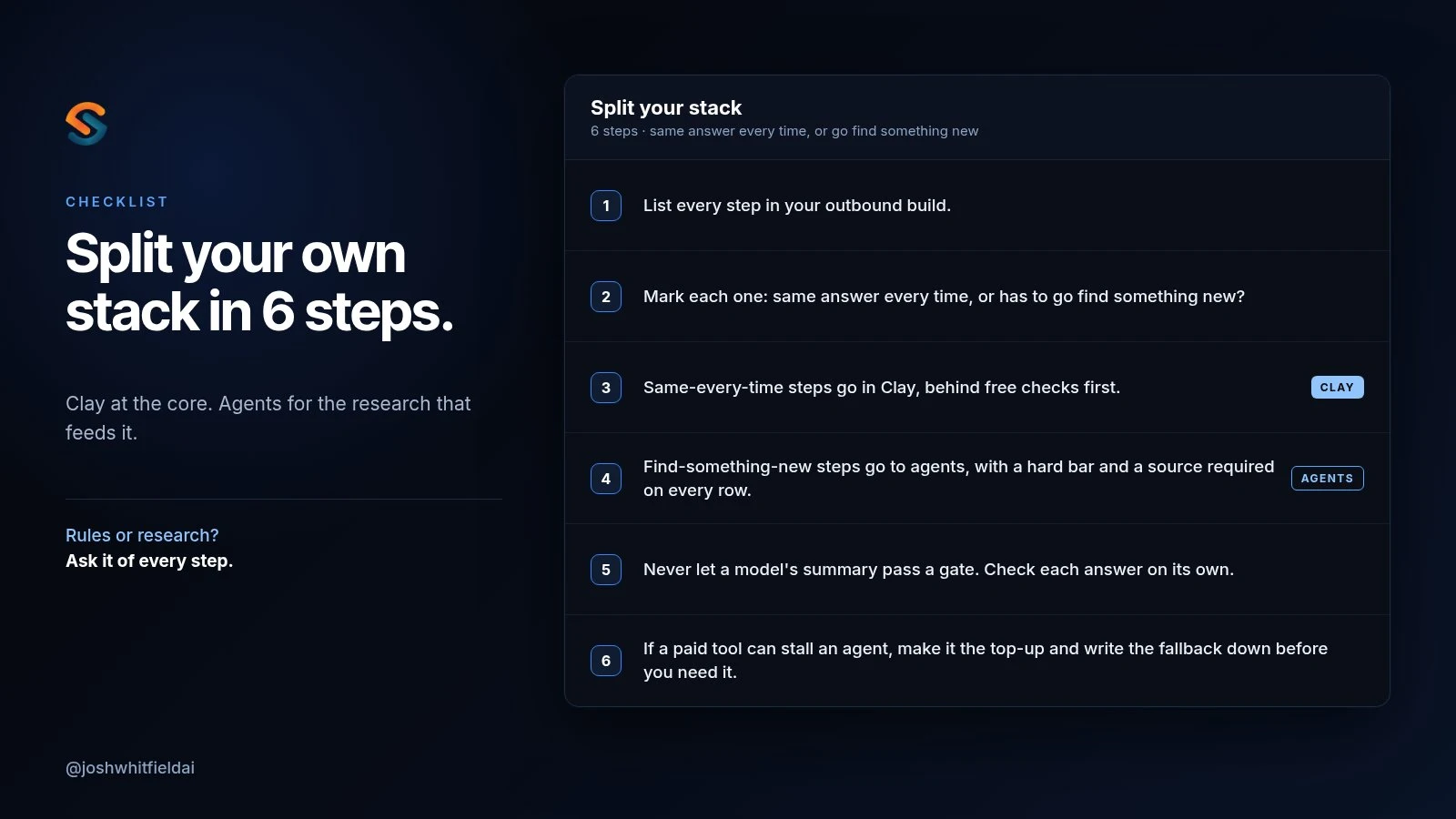
The checklist to split your own stack
1. List every step in your outbound build.
2. Mark each one: same answer every time, or has to go find something new?
3. Same-every-time steps go in Clay, behind free checks first.
4. Find-something-new steps go to agents, with a hard bar and a source required on every row.
5. Never let a model's summary pass a gate. Check each answer on its own.
6. If a paid tool can stall an agent, make it the top-up and write the fallback down before you need it.
It was never Clay vs Claude Code. Clay is the core every build runs on, and agents do the research that feeds it. The real question is which of your steps are rules and which are research.
What's one step in your stack you moved into Clay, or handed to an agent?
Article figures