15,000+ Companies Judged in Clay: Jev, Decisions API and Parallel Decisions
How can a team qualify companies in Clay before finding contacts?
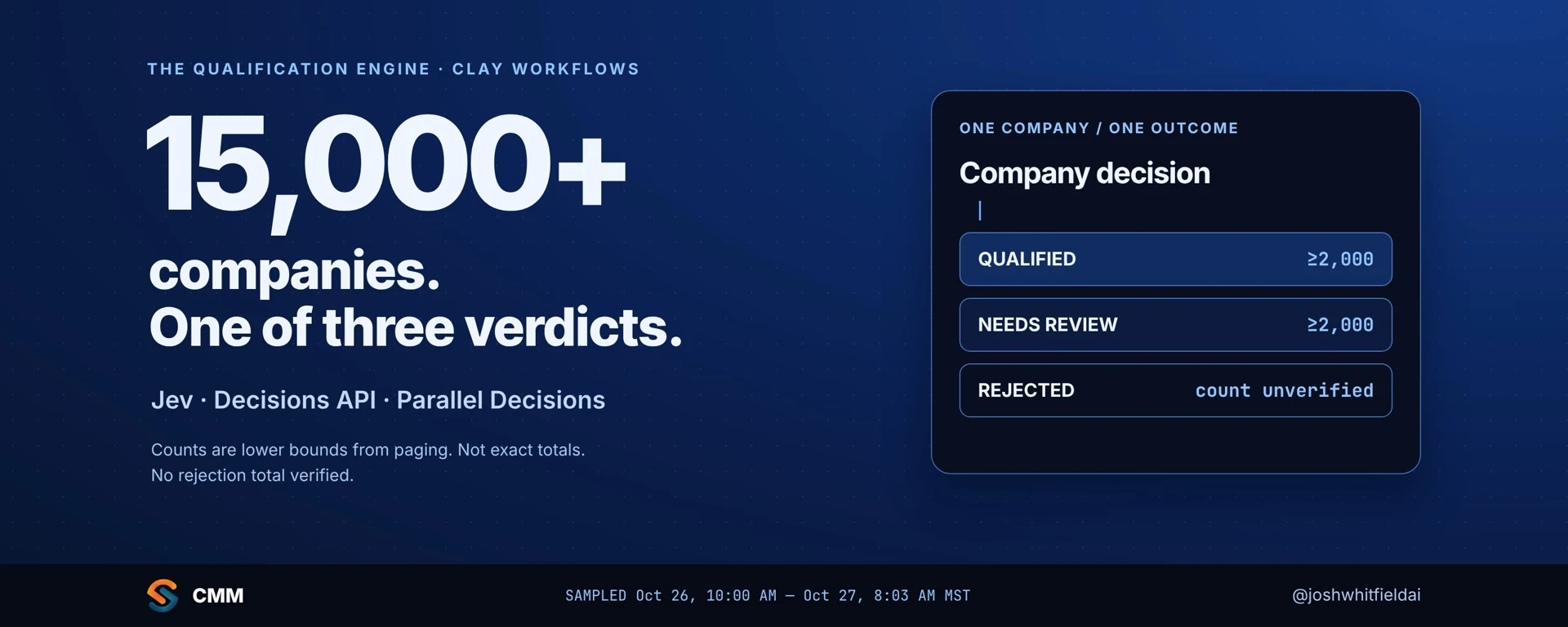
CMM applied fixed rules, Jev, the Decisions API and Parallel to company records. At least 15,000 received a verdict, including at least 2,000 qualified and 2,000 sent for human review.
In this article
At least 15,000 companies got a verdict from one Clay decisions workflow for a single client.
Every one of them landed in one of three buckets: qualified, needs review or rejected. At least 2,000 were qualified. At least 2,000 went to a human for review. I'm saying "at least" on purpose. Those are the floors I could prove by paging through the records in Clay Audiences. The real totals are higher, and I'm not going to guess them.
Last week we got a new client. Before we find a single email, we need to know which companies are worth emailing. This is the engine that answers that, written so you can rebuild it from this page.
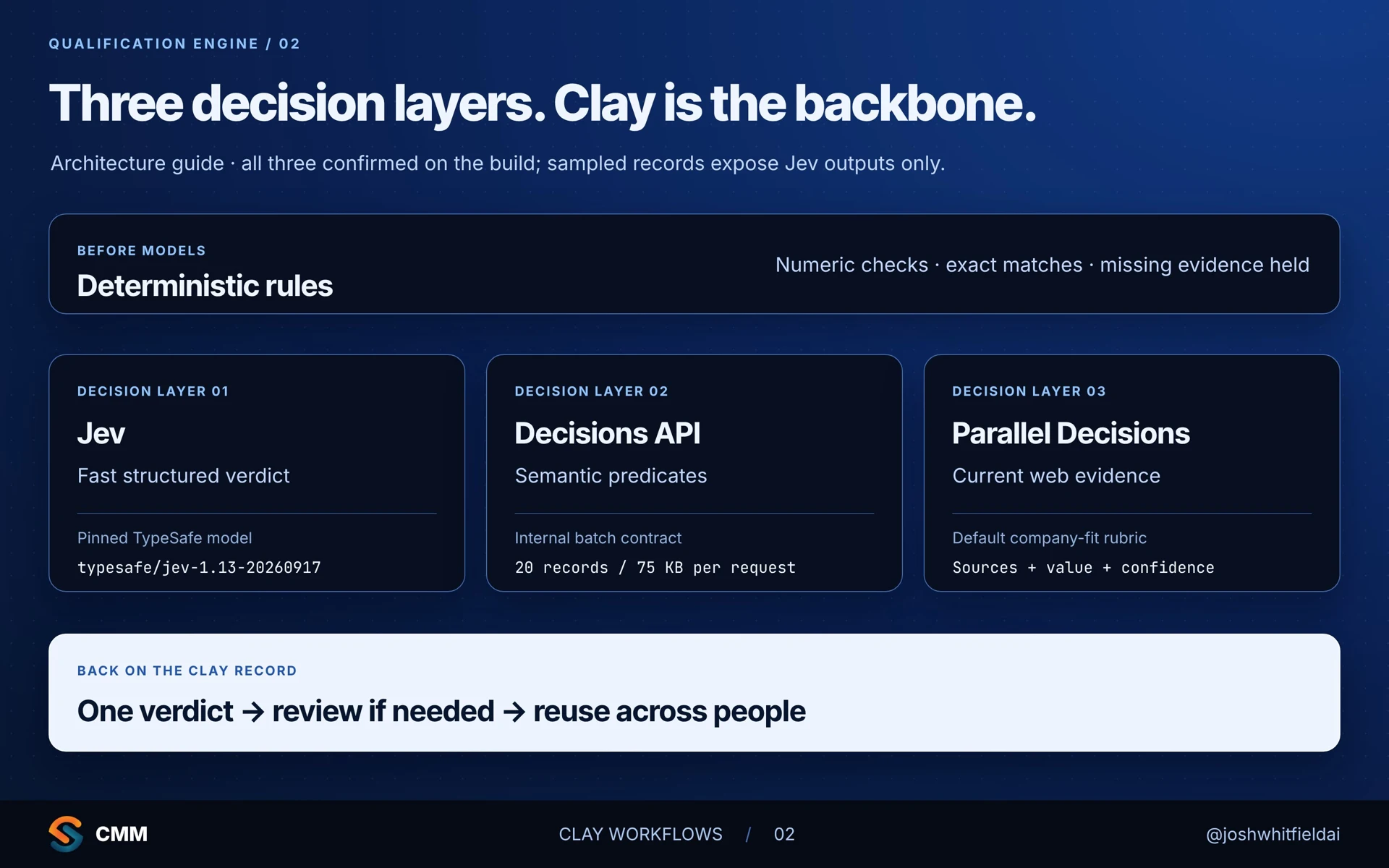
Three decision layers do the work: Jev, a Decisions API, and Parallel's Decisions API. Every one runs inside the same Clay workflow and writes back to the same Clay record. No client names, no prospect names. Every number is from a Clay record, a receipt or something I've already published.
1. The scoreboard, and what it doesn't prove
What I can prove from the records:
Companies with a verdict for this campaign: at least 15,000. Where it comes from: Clay Audiences, paged by offset.
Qualified: at least 2,000. Where it comes from: same.
Needs review: at least 2,000. Where it comes from: same.
First verdict: Oct 26, 10:00 AM MST. Where it comes from: the Decided At field.
Rule set changed: 7 minutes later, 10:07 AM MST. Where it comes from: the rule hash on each record.
Latest verdict I sampled: Oct 27, 8:03 AM MST. Where it comes from: the Decided At field.
What it doesn't prove: a verdict isn't a meeting. These are companies judged worth emailing, held for a person, or cut. Nothing here says how many of them will reply.
Rule: report the count you can prove, and say which kind of count it is.
2. Why decisions are the new layer
For two years the default AI step in a GTM build has been "ask an LLM a question and read the paragraph." That works for research. It's bad for qualification, because a paragraph can't be filtered, counted or audited.
A decision model is different. You give it a fixed set of questions and it returns a fixed set of answers. Each answer has a value and a confidence. No prose. That makes it a column you can sort by, gate on and check.
Here's how Parallel describes the problem: "System One models like Jev (a.k.a. Decision Models) can answer in an instant, but they lack the recency of current news, just like LLMs." Their fix was to combine that speed with live web retrieval.
That's why we run three of them, not one:
Jev answers fast, structured questions from what's already on the record.
A Decisions API handles the predicates that need judgment about meaning, in tight batches.
Parallel's Decisions API answers the questions that depend on what's true this week, by reading the web.
Rule: if the answer has to be filtered later, ask for a value and a confidence, not a paragraph.
3. The shape of the engine
Everything hangs off one rule: every layer reads from and writes back to the same Clay record.
Rules. Fixed checks run as code in one pass: size, geography, revenue bucket, exclusions. Most companies stop here.
Jev. A pinned decision model answers five questions per company.
Decisions API. Semantic predicates the rules can't express, sent in batches.
Parallel Decisions. A web-grounded rubric for anything that depends on current facts.
Floor and verdict. Every company gets qualified, needs review or rejected. Anything under the confidence floor goes to a person.
Reuse. The company verdict is computed once and reused for every person at that company. People are checked on their own.
If a verdict isn't on the record, nothing downstream can use it. And if it is on the record, anyone can check it. You may think this is a lot of effort, but the art of lead generation, and getting qualified leads has changed.
Article figures