Name It Before You Act On It: How Our GTM Agents Label Errors, Guesses and Gaps
How should a GTM agent report guesses and missing evidence?
CMM labels candidates, verified matches, errors and gaps before acting. Each count includes its denominator, and the agent reports which sources it could actually inspect.
In this article
Our agents don't break because they're dumb. They break because they put the wrong label on something and then act on the label.
A filter error gets called a lockout. A guessed social handle gets counted as a match. A reply the agent couldn't open gets reported as quiet. A candidate under review gets reported like a lead. Each one looks small. Each one turns into hours lost, a bad row, or a panic you didn't need.
So every agent we run for outbound and campaign builds has one job before it acts: name what it's looking at. Here are the rules, copy-paste ready, with the real screenshots from one Saturday of runs.
A misread error is worse than an error
Saturday night I checked on a long data job. One of our agents was pulling a big segment of companies out of a CRM for a build.
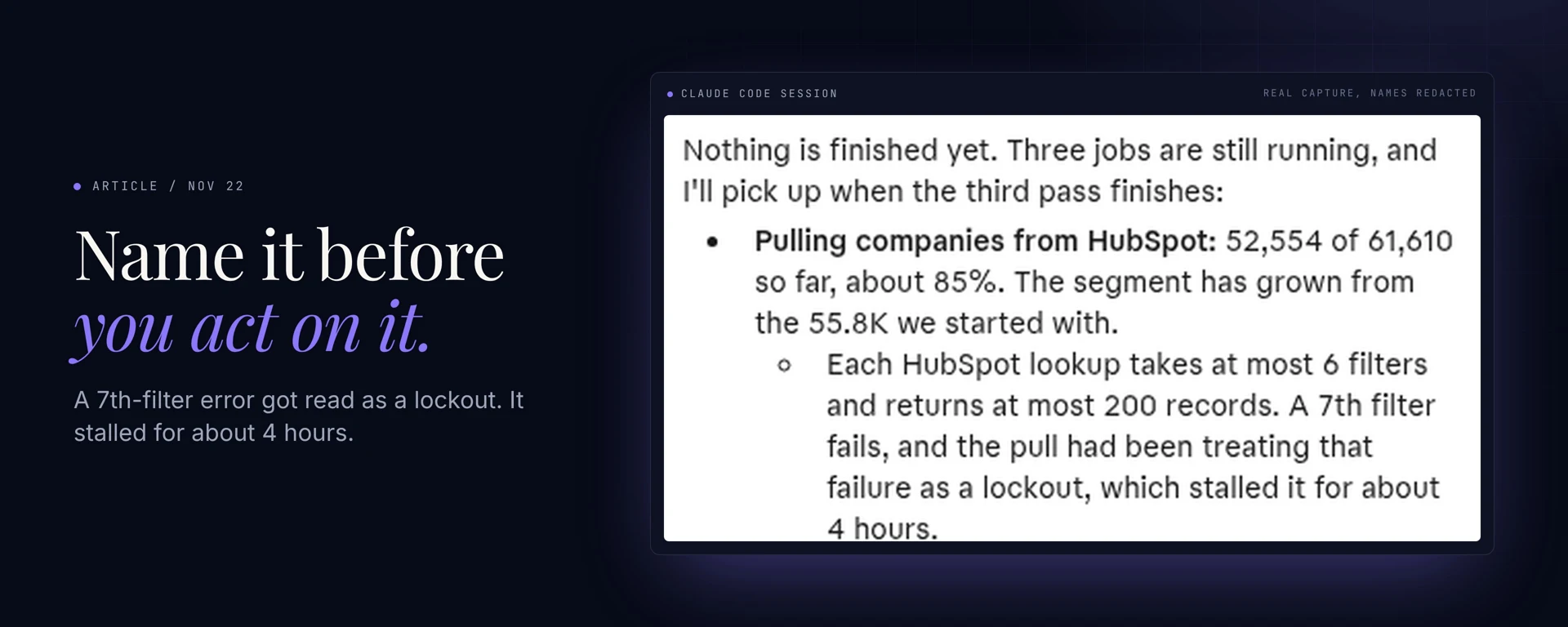
It had stalled for about 4 hours. Not because the CRM was down. Each lookup takes at most 6 filters and returns at most 200 records. A 7th filter fails, and the pull had been treating that failure as a lockout. So it sat there waiting out a lockout that never existed.
Once the agent named the error correctly, the fix was boring. Two follow-up passes added about 2,600 companies. A third pass, split by country, and by state in the US, was running. And it told me the fallback if a big gap was still left: a one-time export from the account owner.
The lesson: an error is cheap. A misclassified error is expensive, because the agent picks the wrong response and keeps picking it.
That last line is the one that would have saved us 4 hours. The 30 minutes is an example. Pick your own number, but pick one.
A guess needs a proof, not a confidence score
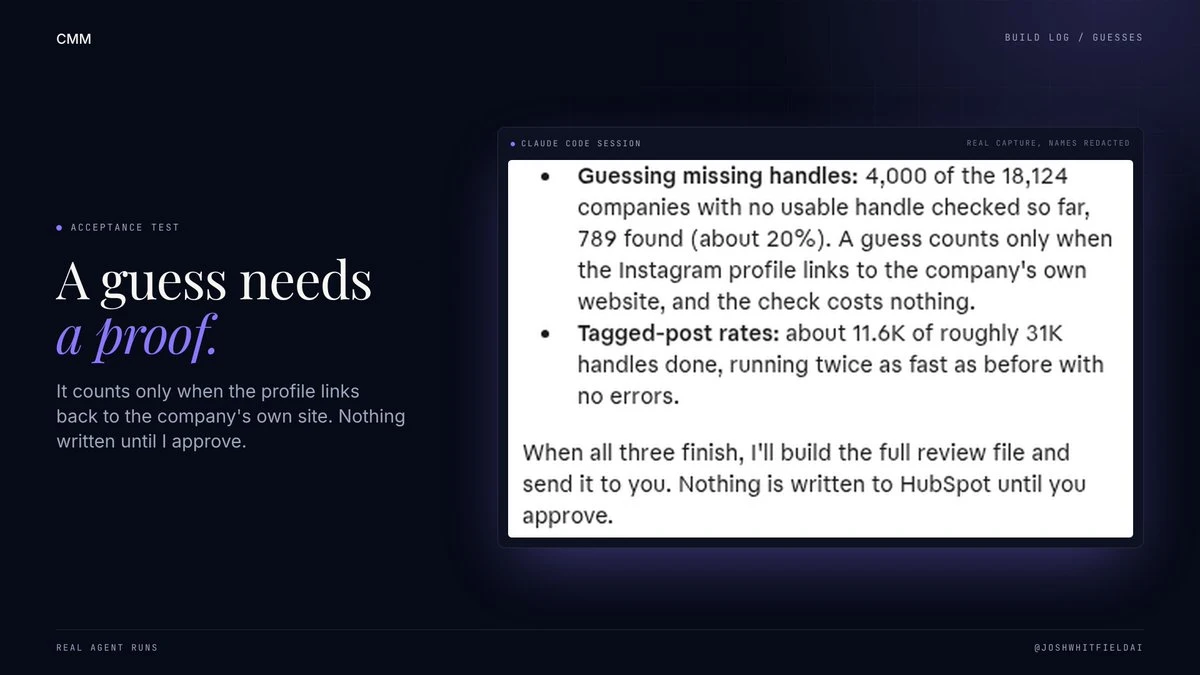
Same job, second thread. Thousands of companies had no usable social handle, so the agent was guessing them. By that update it had checked 4,000 of 18,124 and found 789, about 20%.
That number is low on purpose. A guess counts only when the profile links to the company's own website. No link back, no match. It doesn't matter how similar the name looks.
Most enrichment I see in the wild does the opposite. It fills the field, slaps a confidence score on it, and lets the score do the lying. Say a handle scores 0.82 confidence (a made-up number) and belongs to a different company. It's still wrong, and it still gets used.
Write the acceptance test before the agent starts guessing.
And notice the write rule. Its last line on that update: when all three jobs finish, it builds the full review file and sends it to me, and nothing gets written to the CRM until I approve. Three jobs were still running and it said so plainly: "Nothing is finished yet." The output is a review file, not a write.
Candidates can lose
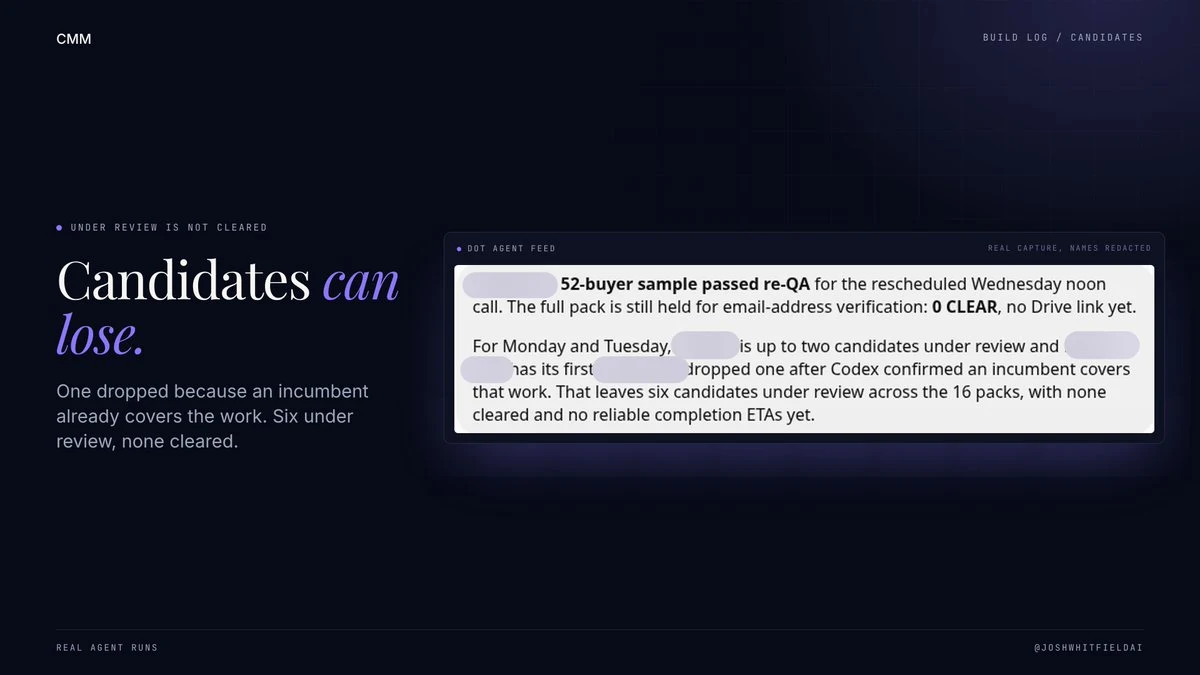
On our pre-call builds, accounts go into review before they count. The under-review number moves both ways, and the agent reports both directions.
At 12:51 PM Saturday it reported six candidates under review across 16 packs, and in the same update it dropped one after Codex confirmed an incumbent already covers that work. By early evening it was ten, then 11. Through all of it: 0 cleared.
That drop is the system working. An incumbent is a real reason to pull an account, and the agent said exactly that reason out loud. If your counts only ever go up, your agent isn't reviewing anything. It's collecting.
The rule: every drop gets a reason. "Dropped: incumbent covers it" is useful. "Updated the list" is not.
Say what you can't see
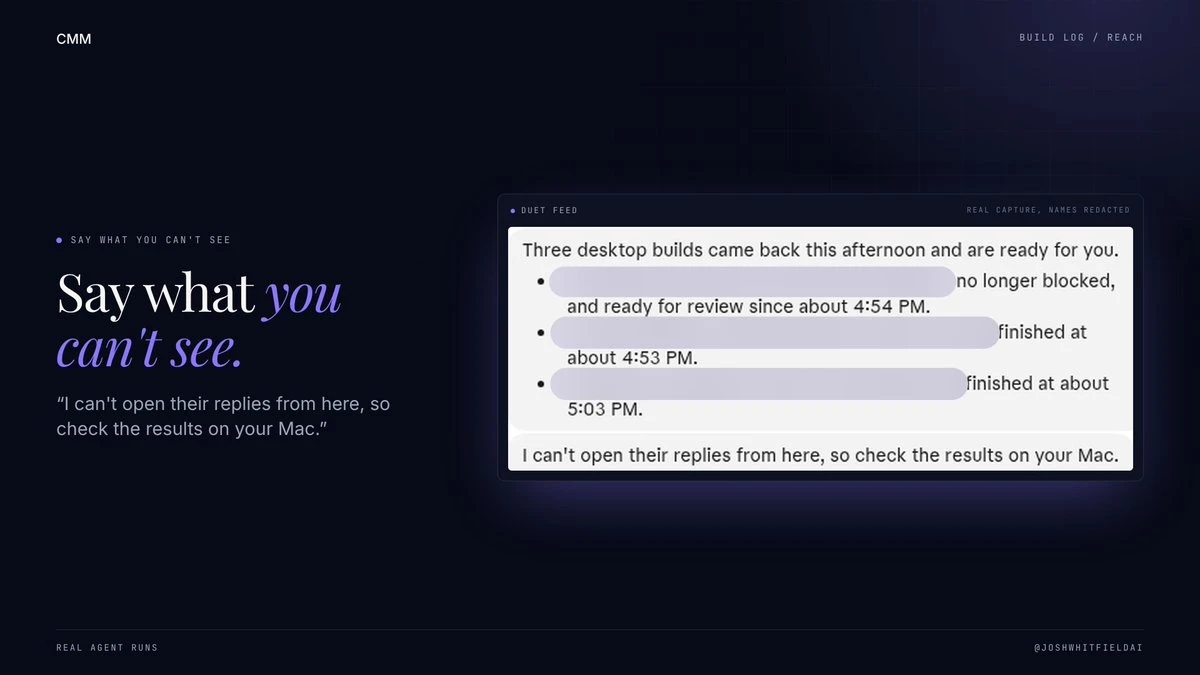
Our agent in Duet watches our desktop build sessions. It can see that a session finished or got blocked. It can't open every reply.
So it says that, every time. Three desktop builds came back one afternoon, ready for review. Then: "I can't open their replies from here, so check the results on your Mac."
That sentence sounds like a limitation. It's actually the most trustworthy line in the whole feed. The worst status report is the one that sounds complete because it skipped the part it couldn't reach.
Give every number its denominator
Back to the CRM pull. Its progress line wasn't "almost done." It was 52,554 of 61,610, about 85%. And it flagged that the segment had grown from the 55.8K we started with.
That second part matters. If the denominator moves and nobody says so, 85% means nothing. A percent without its total is a vibe.
The labeling checklist
This is what every one of our agents gets before it reports anything.
Built is not sent. Guessed is not matched. Under review is not cleared.
Your agent doesn't need to be right about everything. It needs to be honest about what kind of thing it's looking at.
Article figures