Evidence or It Didn't Happen: The Pre-Send Checks Our Agent Runs Before Anything Leaves
What evidence should a GTM agent check before sending?
CMM checks promises against the call, reconciles counts and requires a receipt for anything reported as sent. Matches need evidence, estimates need labels and unresolved checks trigger a hold.
In this article
- The checker matters more than the writer
- "Sent" needs a receipt
- Read the paper against the call
- Never put a promise in writing you can't measure
- Counts reconcile or they don't ship
- A reply is not a green light
- Old numbers are not new numbers
- Say what you didn't check
- Evidence for every match, a label on every estimate
- When it's not sure, it stops
- The checklist before anything leaves
Everybody's building agents that write. Emails, SOWs, follow-ups, reports. Fine. Writing is the easy part now.
The most useful agent output I read this week wasn't writing. It was an agent reading what we were about to send and telling us what was wrong with it.
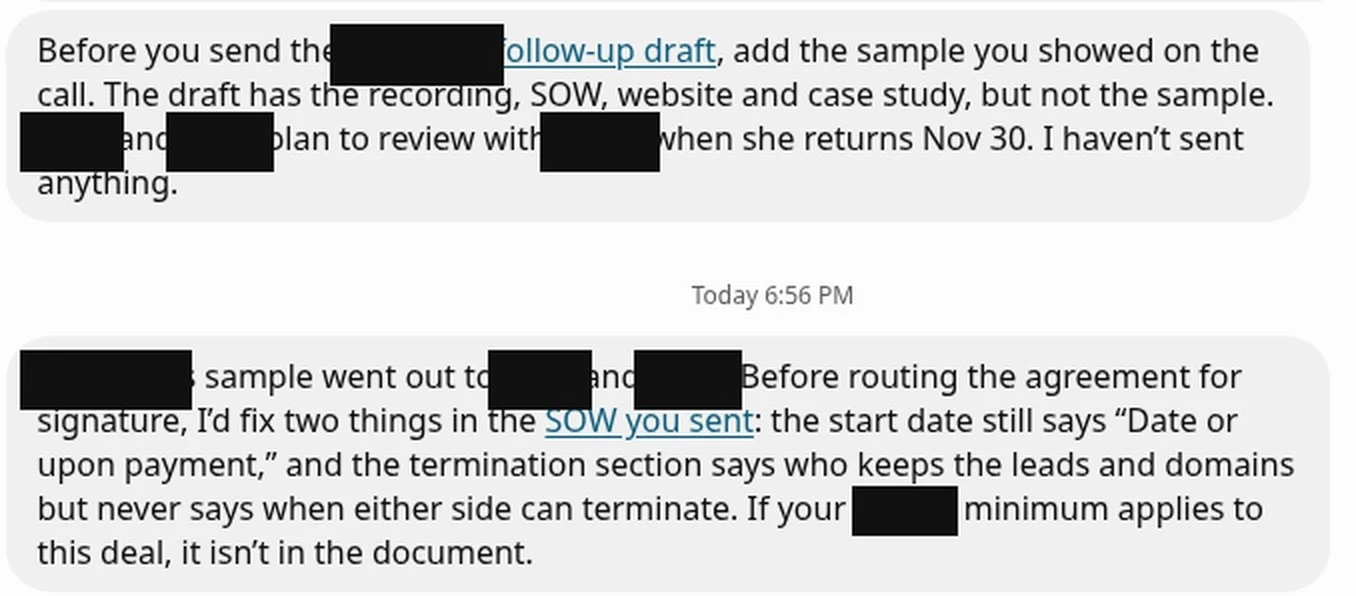
One day on our Dot feed: an agreement out for signature that didn't match the call. A draft SOW promising open-rate reporting after we told the buyer we don't track opens. A follow-up missing the sample the buyer saw on the call. A lead report whose numbers didn't add up the day before launch. None of it was sent by the agent. All of it got caught by the agent.
This Article is the rule set behind that. What the checker looks for, the exact prompt shapes, and the format it uses to tell you what it did and didn't verify. Copy the templates. Change the names. Keep the rules.
The checker matters more than the writer
The cost of a bad email is one bad email. The cost of a bad SOW, a wrong count in a client report, or a reply you treated as a yes when it wasn't is a deal, a launch or a relationship.
So we split the job. Writers write. A separate agent reads what's about to leave and checks it against the source: the call, the thread, the list, the system of record. It doesn't fix things on its own. It flags them, says what it checked, and leaves the decision with a person.
The rules:
The checker is not the writer. Never let the agent that drafted something approve it.
Every check compares the output to a source. No source, no check.
The checker flags. A person fixes or sends.
Every flag says what was compared, what didn't match, and what the checker did not touch.
"Sent" needs a receipt
Read the last sentence. "I found the sample and recording email, but no evidence the SOW was sent."
That's the most useful sentence an agent can write. Somebody on the team would swear the SOW went out. Maybe it did. But there's no sent message, so as far as the business is concerned, it didn't.
Rules:
Sent means there's a sent message you can open. Not a draft. Not "I'll send it tonight."
When the checker can't find the receipt, it says "no evidence" and names what it looked for. It does not guess.
Built is not sent. Drafted is not sent. Approved is not sent.
Every follow-up task starts by checking whether the last thing actually went out.
Read the paper against the call
This is where deals go sideways. The call goes great. Then somebody writes the paperwork from memory.
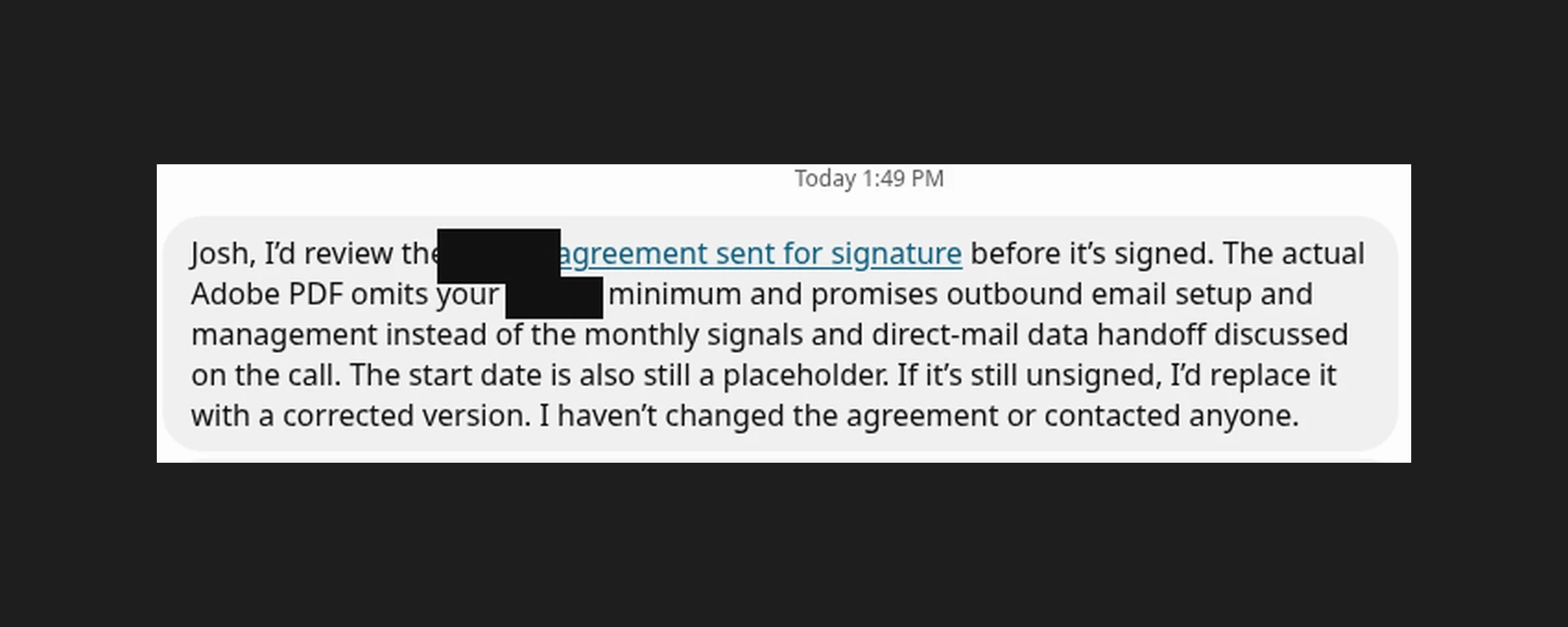
Look at what got flagged in one day. An agreement that promised outbound email setup and management when the call was about monthly signals and a data handoff. A minimum term that was agreed out loud and missing on paper. A start date that still said "Date or upon payment." A termination section that covered who keeps the leads and domains and never said when either side can end it. A follow-up with the recording, the SOW, the website and the case study, and not the sample the buyer saw on the call.
Every one of those is a fight later if nobody catches it now.
Rules:
Every agreement, SOW and recap gets checked against the call notes or recording. Not against the template.
Check scope first. What was discussed vs what the paper promises. Extra promises are as bad as missing ones.
Check the boring fields: start date, signer, minimum term, termination, who owns what after.
Anything promised on the call goes in the follow-up. If the buyer saw a sample, the sample goes in.
The checker says what it didn't do. "I haven't changed the agreement or contacted anyone." That line matters.
Here's the prompt shape. Fill the brackets.
Never put a promise in writing you can't measure
Back to the first image. The checker said to remove the open-rate reporting promise from the SOW. Why? Because we'd already told the buyer we don't track opens.
Think about what happens if that line stays in. Month one, the client asks for the open-rate report. Now you're either building a number you don't trust or explaining why the contract says something you told them on the call you don't do.
Rules:
Every metric in a SOW must be something you already report today. If you can't pull it this week, it doesn't go in.
If you told the buyer you don't do something, it can't appear in writing. The checker compares the two.
Promise the thing you control: what gets built, what gets reviewed, how often you report, how replies reach them.
Counts reconcile or they don't ship
The day before one launch, the checker read a lead report and wrote back: the report says 5,485 verified and 4,000 selected after QA. It separately lists 850 held for employer or domain mismatch, but doesn't reconcile the full 1,485 difference. Verify the count against the source list before calling it a report cutoff.
Do the math. 5,485 minus 4,000 is 1,485. Take out the 850 and there are 635 rows nobody explained. Maybe they're fine. Maybe they're duplicates, or suppressed, or failed a check. The report doesn't say, so nobody knows.
A count that doesn't add up isn't a report. It's a guess with formatting.
Rules:
Every number in a report gets a bucket. In, held, dropped, each with a reason.
The buckets add up to the starting number. If they don't, the gap gets its own line called UNEXPLAINED.
UNEXPLAINED above zero blocks the report, not the campaign. Find the rows, then ship.
Check the count against the source list, not against the last report.
Template. The numbers in brackets are yours.
A reply is not a green light
Same check, same launch. The client's reply asked for targeting and copy changes. The checker's note: "asks for targeting and copy changes, not a green light." She also asked how positive replies reach her and a colleague, what rates we're targeting and how often we'll report. None of that had been answered.
Most teams see "replied" in the thread and hit go. A reply is a message. Read what it actually asks for.
The same goes for prospect replies. On one afternoon's list: one wanted a demo after a date, one wanted two times in his time zone, one "wants to learn more," and the checker's note was to clarify whether he's looking to buy or partner. Another had gotten a reply from us but still hadn't received the concrete lead example he asked for.
Rules:
Every reply gets classified by what it asks for, not by tone. Approval, change request, question, scheduling, or no.
Change requests are not approvals. Nothing launches on a change request.
List every question in the reply. The next message answers all of them or says when.
"Interested" is not a status. Write the next step the reply actually asked for.
If they asked for an example, the example is the deliverable. A reply without it doesn't count.
Old numbers are not new numbers
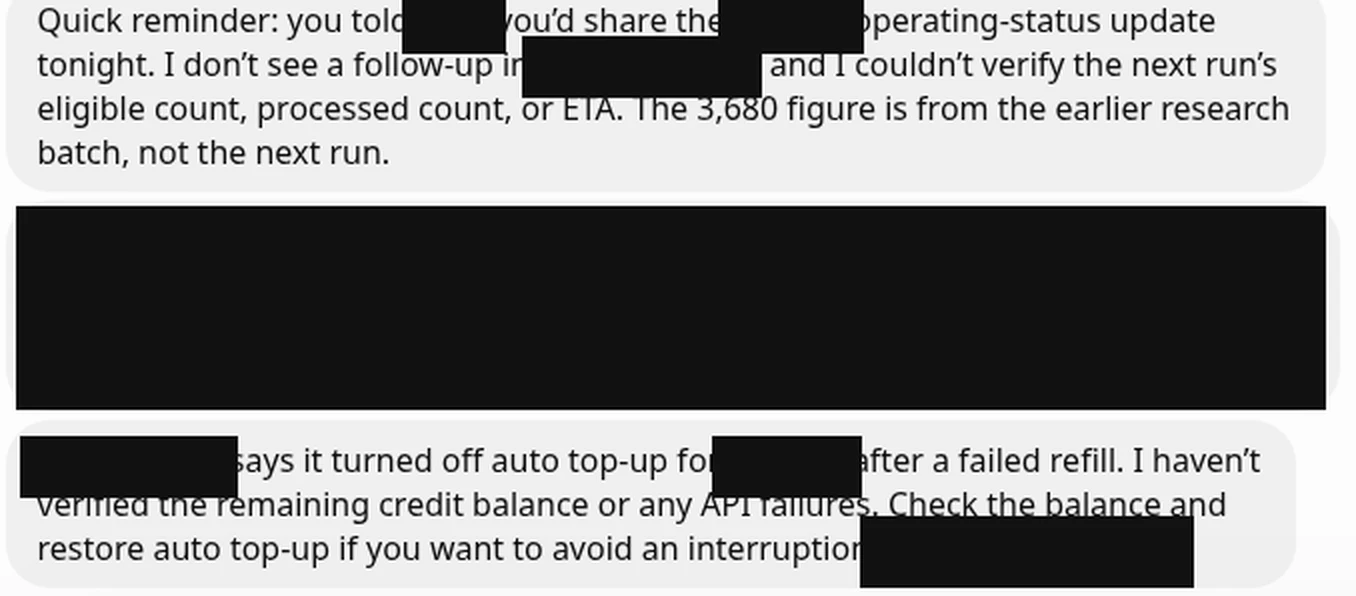
This one is sneaky. Someone promised a client an update on the next run. The only number lying around was 3,680, and it was from the earlier research batch. The checker refused to pass it off as the next run.
That's how bad updates get made. Not by lying. By grabbing the closest number in the thread and letting the reader assume it's current.
Rules:
Every number in an update carries where it came from and when.
A number from a previous batch is labeled as the previous batch. Always.
If you can't verify eligible, processed and ETA for the next run, say that. Don't fill the gap with history.
Say what you didn't check
Look at the bottom of that image. A vendor turned off auto top-up after a failed refill. The checker said exactly that, then said what it hadn't verified: the remaining balance with the vendor, and any API failures.
That's the format I want from every agent. What happened, what it checked, what it didn't. An agent that only tells you what it did is hiding the part you need to worry about.
Rules:
Every flag ends with what wasn't verified.
Every flag ends with what the agent did not change. "I haven't sent anything." "I haven't changed the agreement or contacted anyone."
"Not verified" is a fine answer. A confident guess is not.
Evidence for every match, a label on every estimate
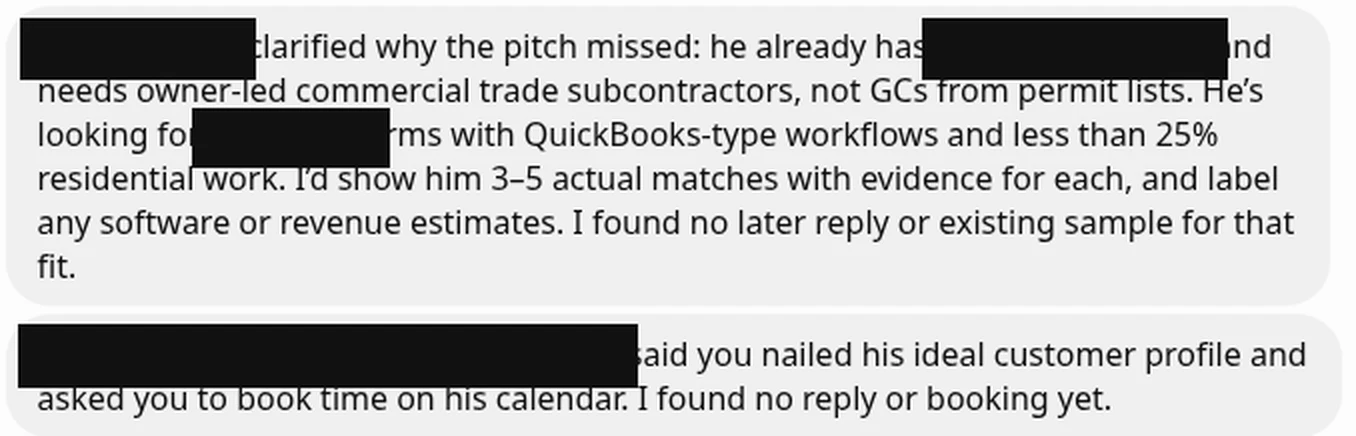
A prospect told us exactly why the pitch missed. Wrong kind of company. He wanted owner-led commercial trade subcontractors, not general contractors pulled from permit lists. He gave a size range, a software profile, and a cap on residential work.
The checker's suggestion wasn't "rewrite the email." It was: show him 3 to 5 actual matches with evidence for each, and label any software or revenue estimates.
That's the whole game in outbound now. Anyone can claim they found your ICP. Showing five real companies with the reason each one fits, and being honest about which parts are estimates, is what gets the second call.
And notice the second message. A prospect said we nailed his ICP and asked us to book time. The checker found no reply and no booking. A buyer asking for a meeting and nobody booking it is the most expensive miss in the business.
Rules:
When a prospect tells you why it missed, the next message is examples, not copy.
Every example carries its evidence. Where the fact came from.
Anything inferred gets labeled as an estimate. Revenue, headcount, software stack.
Every "book time with me" gets checked for a booking. No booking, it's the first flag of the day.
When it's not sure, it stops
Last thing. Thursday night our Dot got paused out of precaution: "We couldn't confirm your dot was interpreting your instructions correctly." Proceed or delete.
Annoying? Sure. Now think about the alternative: an agent that isn't sure what you meant and keeps going anyway.
For a checker, stopping is a feature. If it isn't sure what it's comparing against, the right output is "I stopped, here's why."
The checklist before anything leaves
Was it already sent? Quote the receipt or write "no evidence."
Does the document match the call? Scope, promises, attachments.
Are the boring fields filled? Start date, signer, minimum term, termination, ownership.
Is every promised metric something we report today?
Do the counts reconcile to the source list, with UNEXPLAINED at zero?
Is the reply an approval, or a change request with questions?
Is every number labeled with where it came from and when?
Does every example have evidence, and every estimate a label?
Does the flag say what wasn't checked and what wasn't changed?
Is a person making the call?
Agents that write are everywhere. Point one at your outbox instead. It'll find something this week. Ours found plenty in one day.
Article figures