How We Wired Our Own Pipeline to Octave, and What It Told Us About Our Buyers
What did CMM learn by connecting its sales pipeline to Octave?
CMM connected deal records and discovery calls to Octave to review buyer feedback, wins and losses. Across the 90-day period covered, five wins and 12 losses put its win rate at 29%.
In this article
I spend all day building revenue systems for other companies. So I asked myself a simple question. Would I run this on my own pipeline?
So we did. We wired CMM's own sales process into Octave's revenue engine and let it read everything. Every deal, our discovery calls, every win and every loss.
Here's what it found, what it does every week, and why this is now the live example I show founders who ask what we can deploy for them.
1. What we plugged in
Our deals live in the CMM Lead Tracker in Slack. That's where the team works, so that's where the data came from.
Octave synced it all:
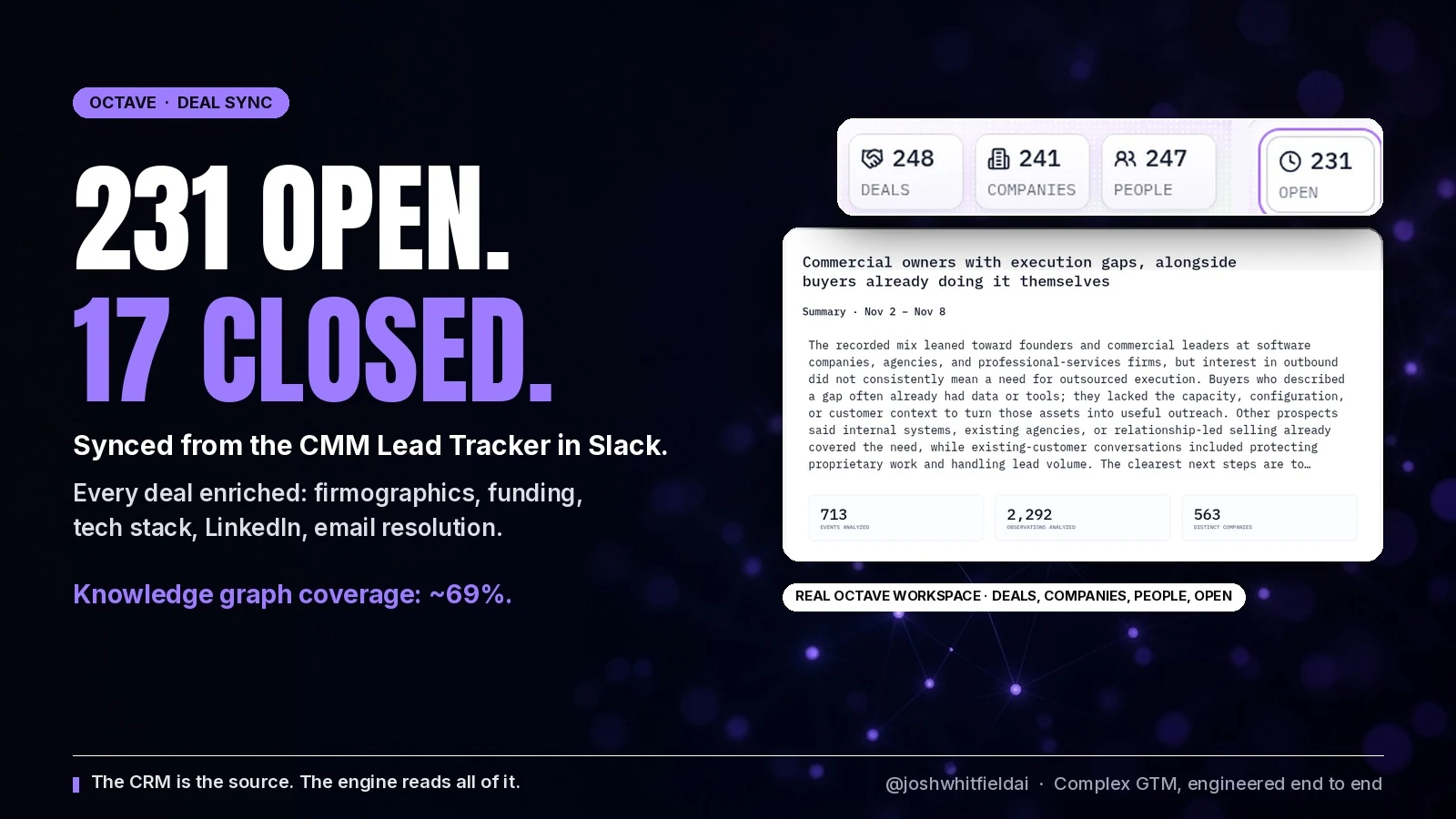
1) 231 open deals
2) 17 closed deals
3) A knowledge graph of our offer, buyers and proof, sitting at about 69% coverage
Then it started doing the work on top.
2. The scoreboard
Over the last 90 days we closed 5 wins and 12 losses. That's a 29% win rate.
Average sales cycle is about 13 days.
Look, I could dress those up. I'm not going to. A 29% win rate on a 13 day cycle is a real number from a real pipeline, and it's the baseline everything else gets measured against. GTM is a science. You don't get to improve a number you won't look at.
3. What the engine actually does every week
This is the part I care about most. It runs every week whether I open it or not.
1) Enrichment on every deal. Firmographics, funding, tech stack, LinkedIn profiles and email resolution. Before anyone on our team touches a deal, the context is already there.
2) Deal Pulse. Every deal gets a health classification and a suggested next action, so the team knows what to do next on each one.
3) Discovery call scoring. Discovery calls get scored. So I can see whether a call actually did its job, not just whether it happened.
4) 8 Weekly Beats. Insight reports covering market changes, deal health, effort allocation, losses, wins, buyer personas and competitors.
5) A suggestions engine. When the same finding keeps showing up and nothing in the library matches it, Octave proposes a new library entry. The system tells us what it's missing.
That last one is my favorite. It's the learning loop. The knowledge graph gets better because the deals keep teaching it.
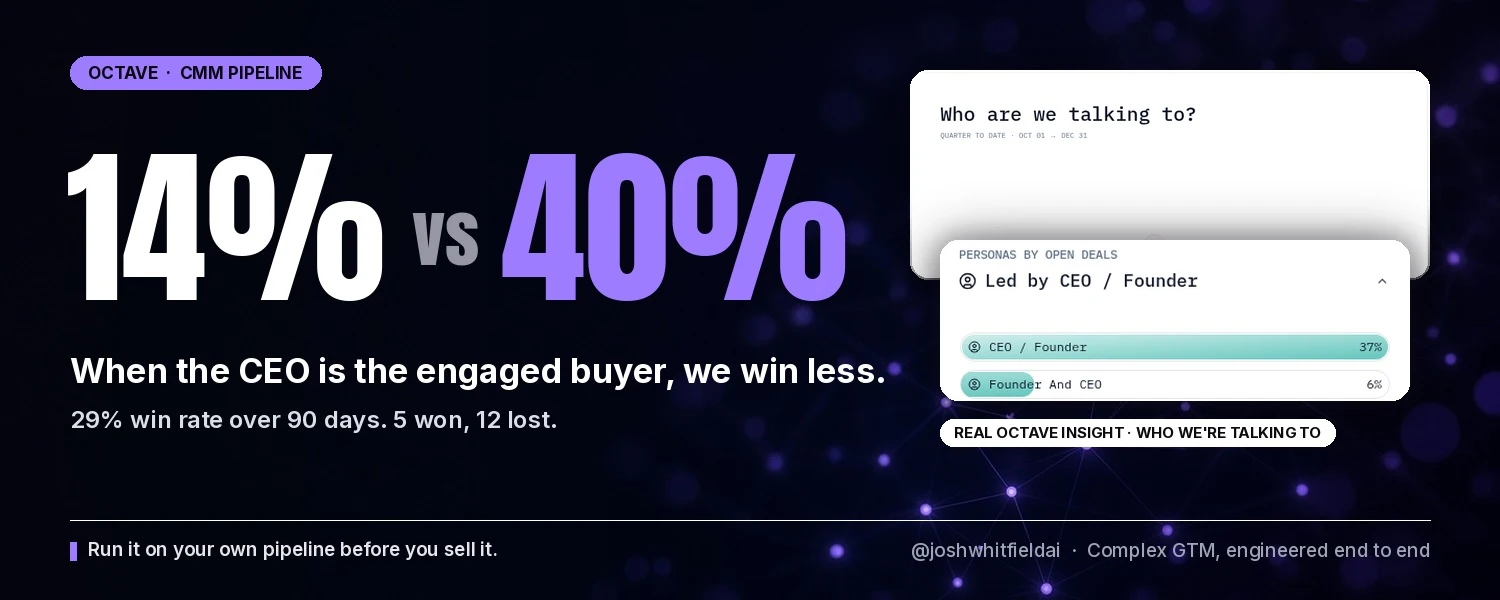
4. The finding that stung: 14% vs 40%
This is the one I keep thinking about.
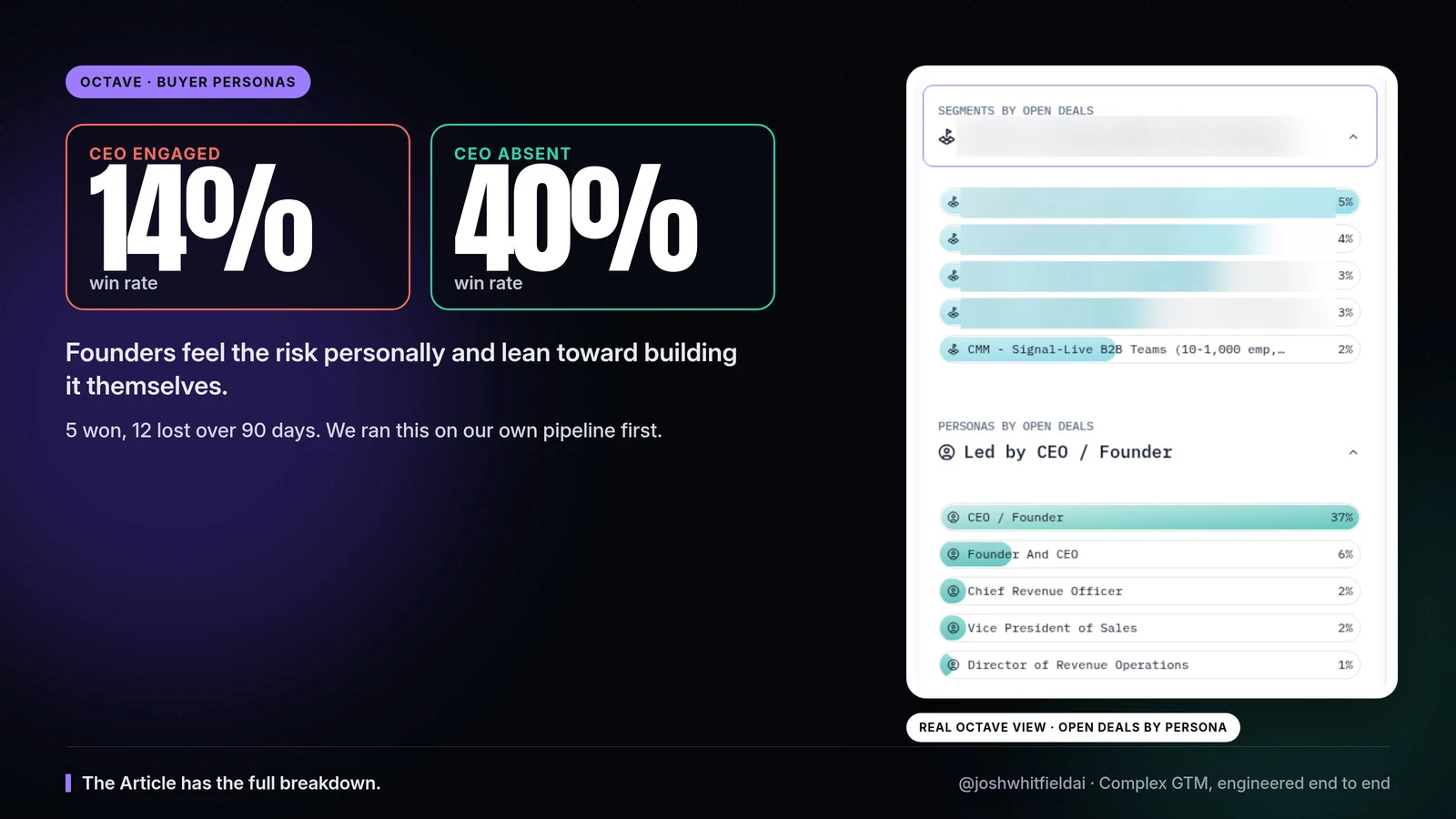
When a CEO or Founder is the engaged buyer, we win 14% of the time. When they're absent, we win 40%.
Honestly, I didn't expect that. I'm a founder. I like selling to founders. Founder to founder feels like the shortest path. The data says otherwise, at least for us, at least for now.
My read: founders feel the risk personally, and they lean toward building it themselves. When the person running the deal owns the outcome day to day, the conversation is about getting it done, not whether to do it at all.
So here's what we're changing because of it:
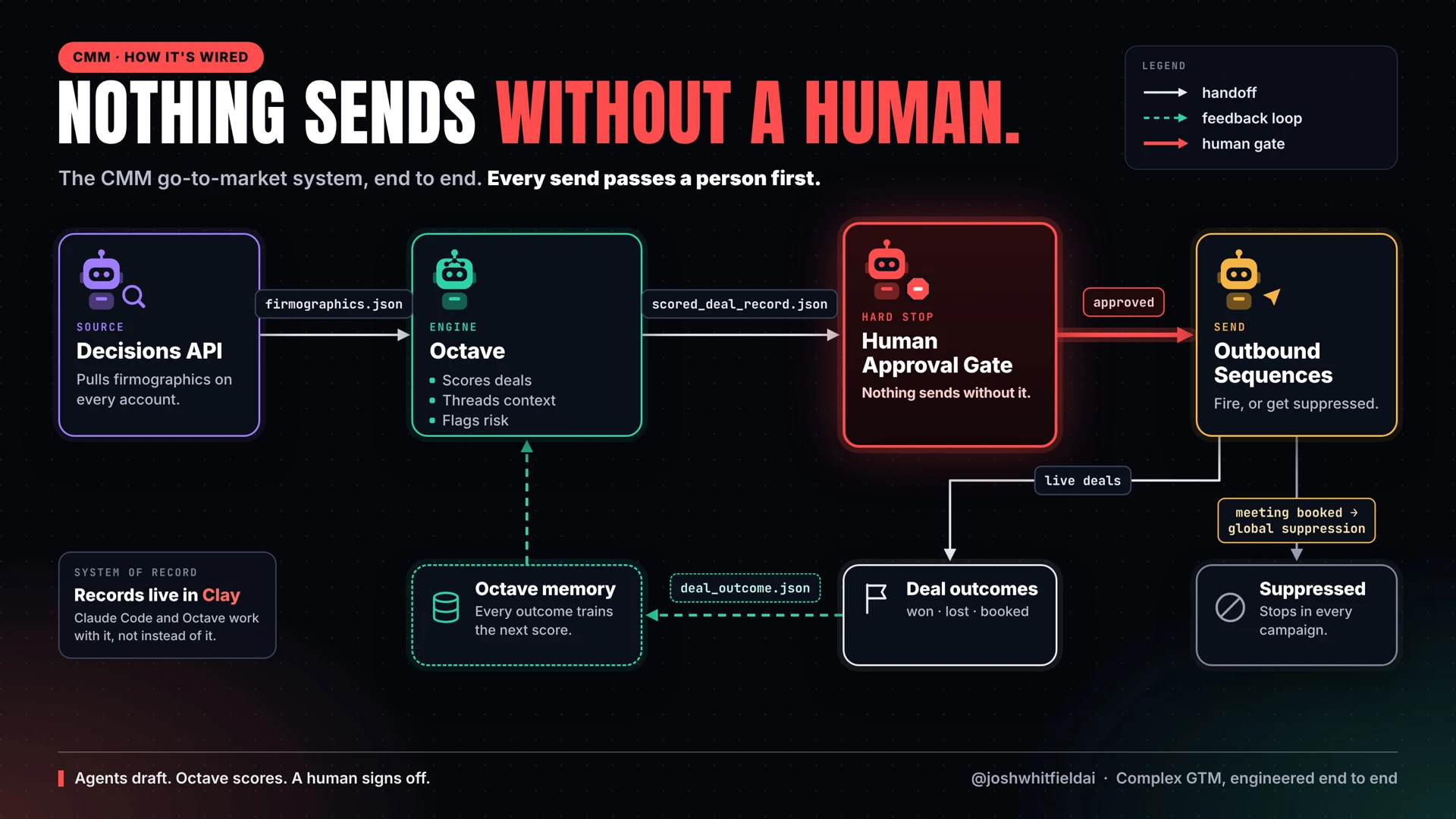
1) A resurrection sequence for at-risk deals. Short, human, fully manual. No automation. Automated outreach already burned a live deal for us after a meeting was booked, and I'm not doing that twice.
2) Global suppression the moment any meeting books. Every outbound sequence stops for that contact, across all campaigns, not just the one that booked it.
3) A tighter Decisions API filter. We're testing a shift toward 50 to 199 employee firms and away from sub-50. Just a test for now.
5. What our buyers keep telling us
Octave pulled three themes out of our calls and deals. None of them were a surprise once I saw them written down, and all three were uncomfortable.
1) They resist paying before results. Buyers want proof first. Fair. We sell receipts, so we'd better show them before the ask.
2) They question what CMM adds beyond tools they already have. Everyone already has a stack. The question is what we do that their stack doesn't do on its own.
3) They can't tell a public signal from buying intent. A funding round, a hire, a launch. Public signals are everywhere. Knowing which ones mean "ready to talk" is the whole game, and buyers can't always see the difference.
That third one is basically our entire business. Find companies that have a reason to talk, not companies that just showed up in a feed.
6. One loss, one win
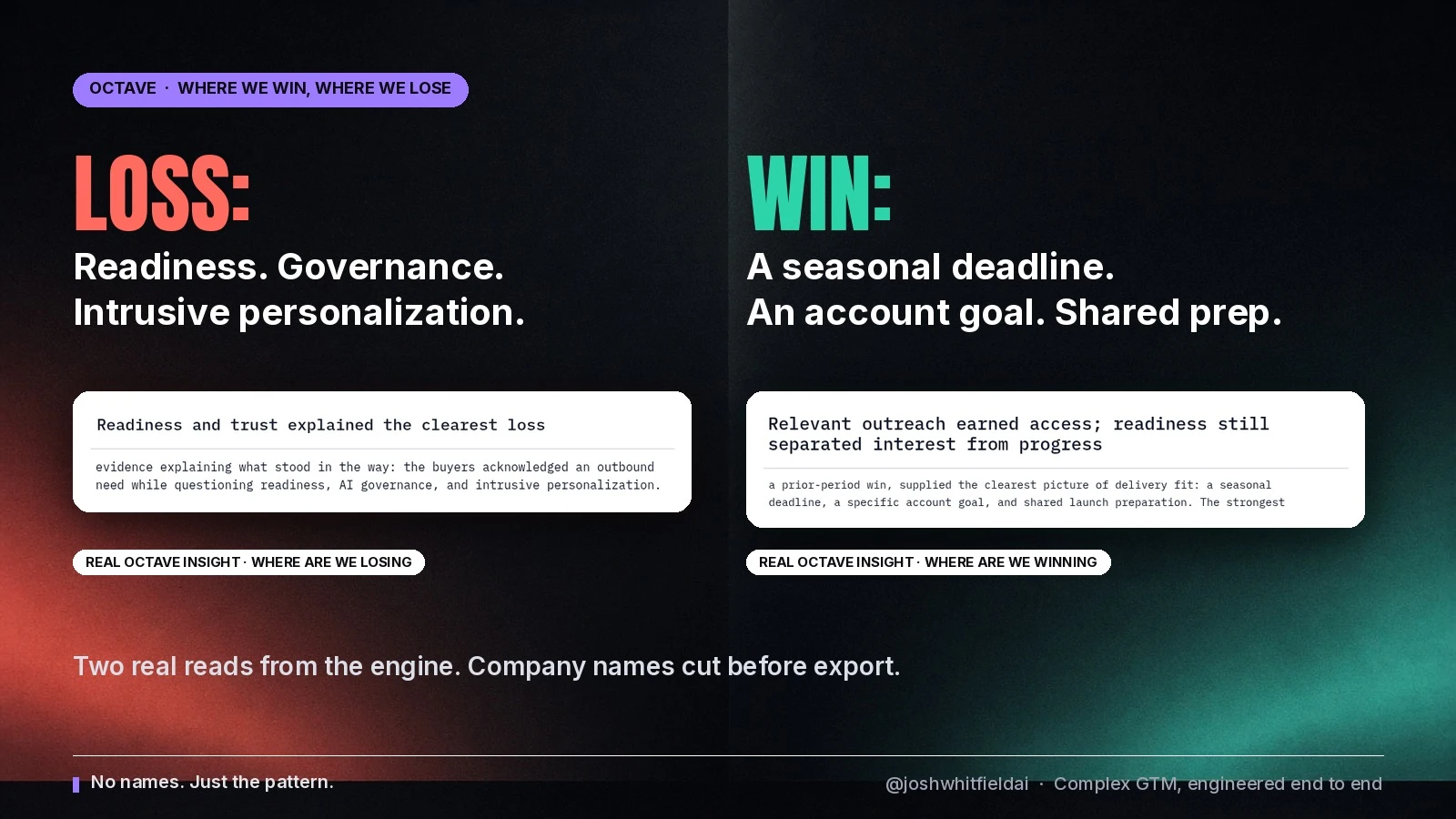
A recent loss. Octave tagged it on three things: readiness, AI governance, and intrusive personalization. They weren't ready. They had real questions about how AI would be governed inside their outbound. And the personalization felt too close for comfort.
I don't love reading that. But it's exactly why we run human approval before anything sends. Governance has to be in the build from day one, before a buyer ever asks.
A recent win. Octave tagged three things here too: a seasonal deadline, a specific account goal, and shared launch prep. They had a date they couldn't move. They knew exactly which accounts they wanted. And we prepped the launch together.
Put those side by side and the pattern is pretty obvious. Wins have a clock and a target. Losses have open questions about trust. The engine just made it impossible to ignore.
7. Why we ran it on ourselves first
What I tell every founder on a call: I won't deploy anything for you that I won't run on my own pipeline.
This is complex GTM, engineered end to end. Data comes in from where the team already works. Enrichment fills in the context. Discovery calls get scored. Deals get a pulse and a next step. Every week the reports come back, the library learns, and the next campaign starts smarter than the last one.
On client builds, Clay holds the records, Octave holds the context, a human approves before anything sends.
No magic agent running wild. A system that reads every deal, tells you what it sees, and leaves the judgment calls to people.
8. If you want to copy this
1) Start where your deals already live. Ours was a Slack tracker. Don't migrate first.
2) Sync open and closed deals both. The losses teach more than the wins.
3) Turn on enrichment before you look at a single insight. Context first.
4) Score your discovery calls, not just the ones that closed.
5) Read the weekly reports for a month before you change anything.
6) Let the suggestions engine grow the library. When findings repeat and nothing matches, that's the system telling you what you don't know yet.
7) Then go look at who your buyer really is. Mine wasn't who I thought.
We built this for ourselves first. Now it's the live example I pull up when founders ask what we can deploy for them. I believe in receipts:)
Article figures