Build the Campaign Before the Demo Call: The One-Hour Pre-Call Pack Playbook
What belongs in a one-hour pre-call campaign pack?
CMM builds a sample campaign around the prospect’s buyers, signals and messaging. The playbook explains the order of work, the checks before a demo and what the prospect receives afterward.
In this article
Someone asked me how long we spend building a campaign before a demo call. My answer was about an hour, and the agents do most of it. This Article is everything in that hour: what goes in the pack, the checks it has to pass, the templates, and what we never put in front of a buyer.
The short version: stop pitching capabilities. Show up with their campaign already built. If it's bad, they see it. If it's good, the conversation stops being "can you do this" and starts being "when do we start."
Companion piece: the decision rules for who gets emailed, who gets a person and who gets dropped are in my GTM Is a Science Article. The pack uses the same rules. This one is about packaging them for a buyer.
All company names and numbers below are made up. Acme is fictional. Every number is an example, not a result.
Why capability demos lose
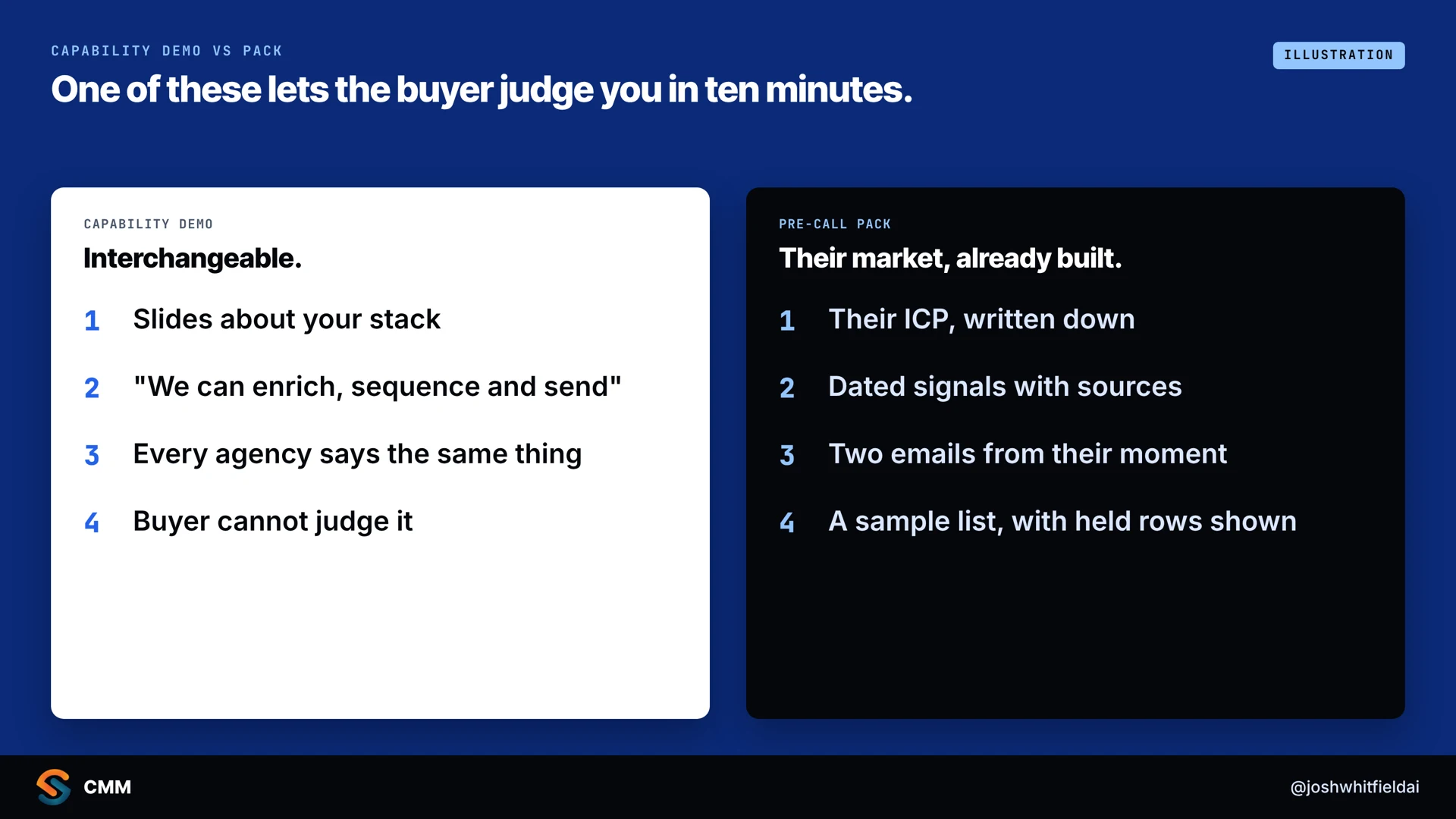
A capability demo answers a question the buyer isn't asking. They already assume you can enrich, sequence and send. Every agency says it can. Slides about your stack are interchangeable with the next agency's slides.
What the buyer can't judge from a deck is whether you understand their market. A pack answers that in ten minutes, because it is their market, their personas and their emails, written before they paid you anything.
Three rules for why we do it:
The pack is the pitch. If the call needs a capabilities slide to be convincing, the pack wasn't good enough.
A pack can fail. That is the point. A buyer who sees a weak signal or a generic email learns something real about you, and so do you. Fix it before the call, not after the contract.
One account, one dated signal. If nothing happened at a company recently, it doesn't get a custom email. It goes in the sample as a "no signal, held" row, and the buyer sees you held it.
What goes in the pack
Six things. No more. A pack with twenty sections is a deck wearing a costume.
ICP in one paragraph: who you would email, who you would not, and the three hard rules that exclude the rest.
Signals: the two or three dated events that make a company worth emailing this week. Hiring a role, a new location, a funding round, a leadership change. Each one has a source and a date.
Personas: the one or two titles per company who would feel the problem, and the pain in their words, not yours.
A sample list: 10 to 25 real accounts that pass the checks below, each with its signal, its date and the person.
Messaging: two or three example emails written from the buyer's moment, not the product's features.
Measurement: what you would count, and what you refuse to count. Replies from humans, not opens.
Rule: if an item can't be shown to the buyer, it isn't in the pack. Internal notes are not a section.
Three checks, never one
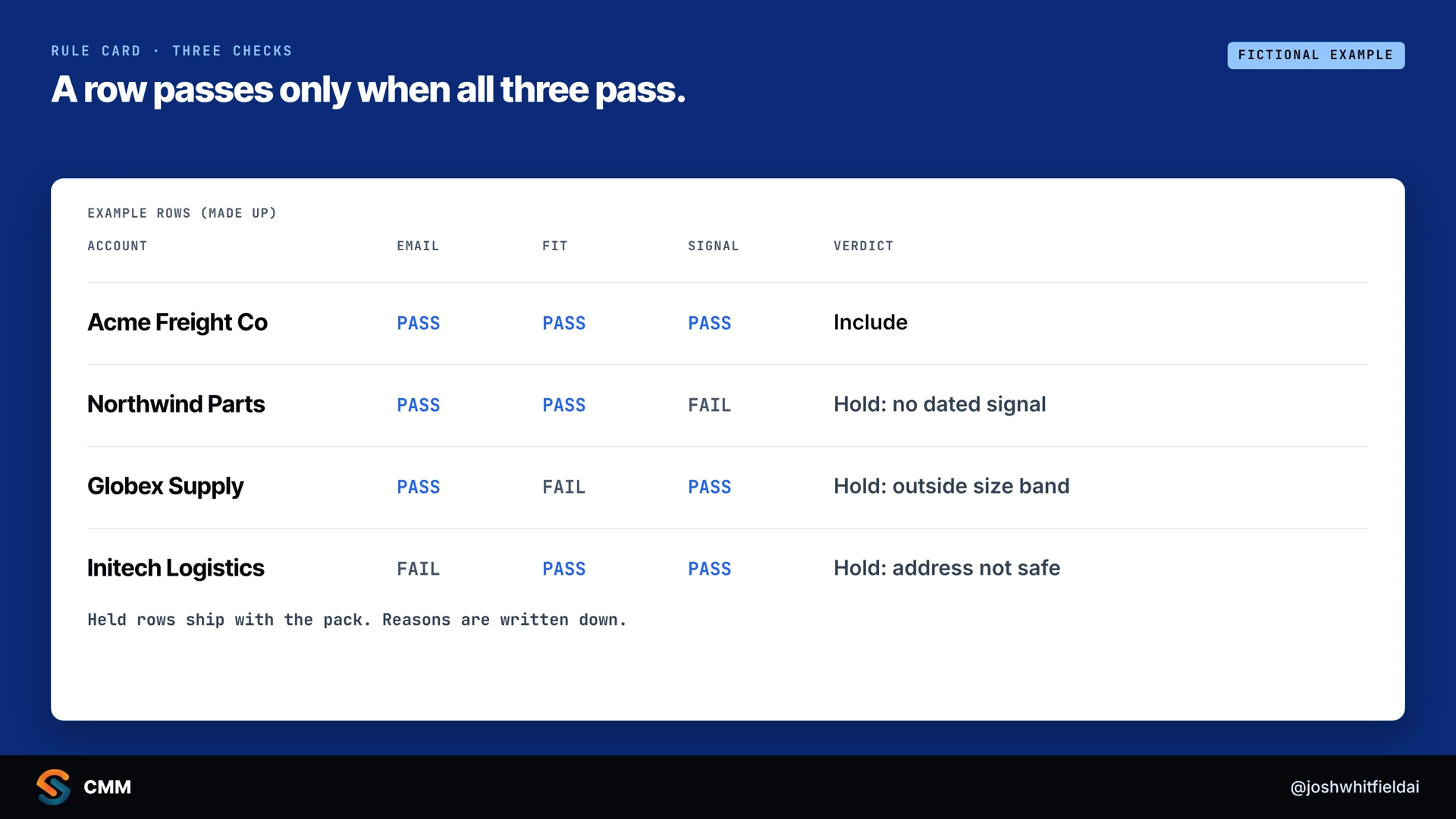
The most common failure in a pack is treating "we found an email" as "we found a buyer." Those are three different questions, and each gets its own check.
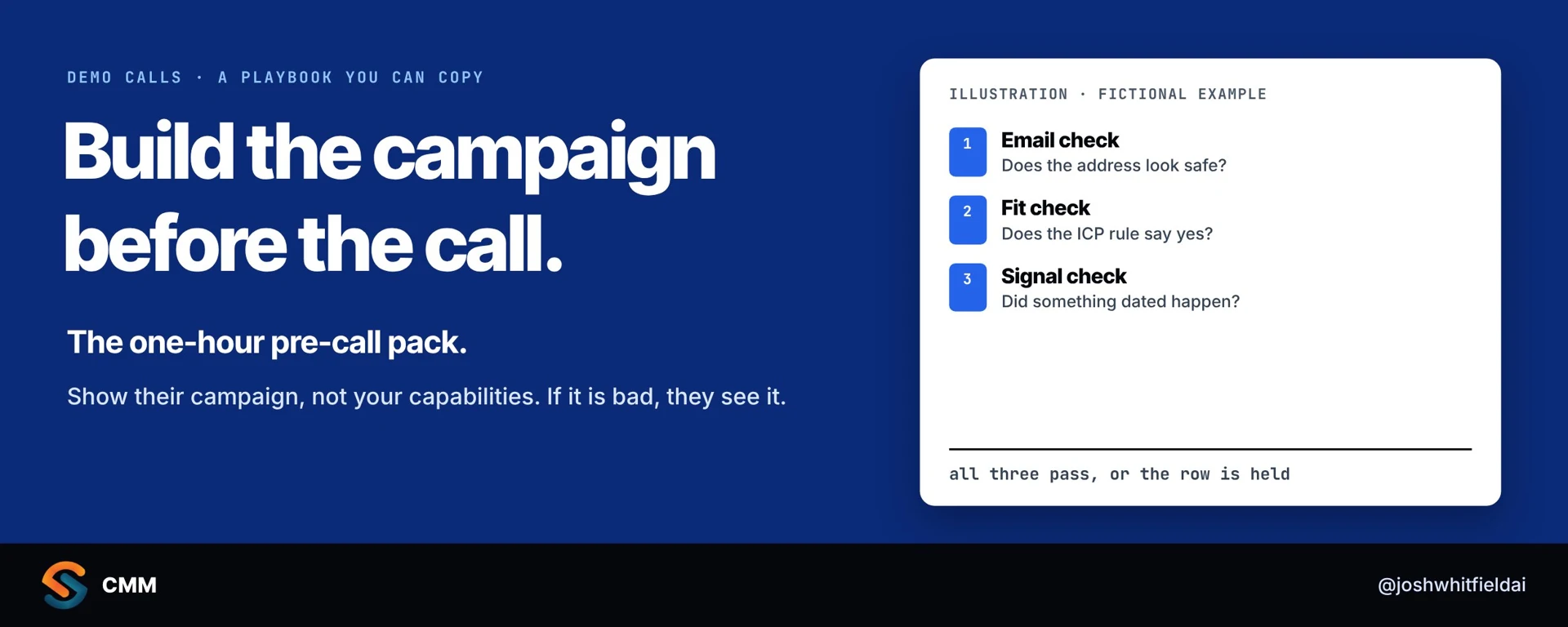
Email check: does this address exist and look safe to send to? That is deliverability hygiene. It says nothing about fit.
Fit check: does this company and this person match the ICP rules? That is a decision, not a lookup.
Signal check: did something dated and verifiable happen at this company recently? That is the reason to write today instead of next quarter.
A row passes only if all three pass. A row that passes two is held, and the reason is written next to it.
Here is the manifest we fill in per account. It is an example for a fictional company:
Rule: verdict is computed from the three checks, not typed by hand. If any check fails, the verdict is hold and hold_reason must be filled. An empty reason is a bug.
The pack template
Copy this. Fill every field or write "none." A blank is not an answer.
Rule: the held rows ship with the pack. A pack that shows only winners looks like a demo. A pack that shows what it held looks like a process.
The one-hour run order
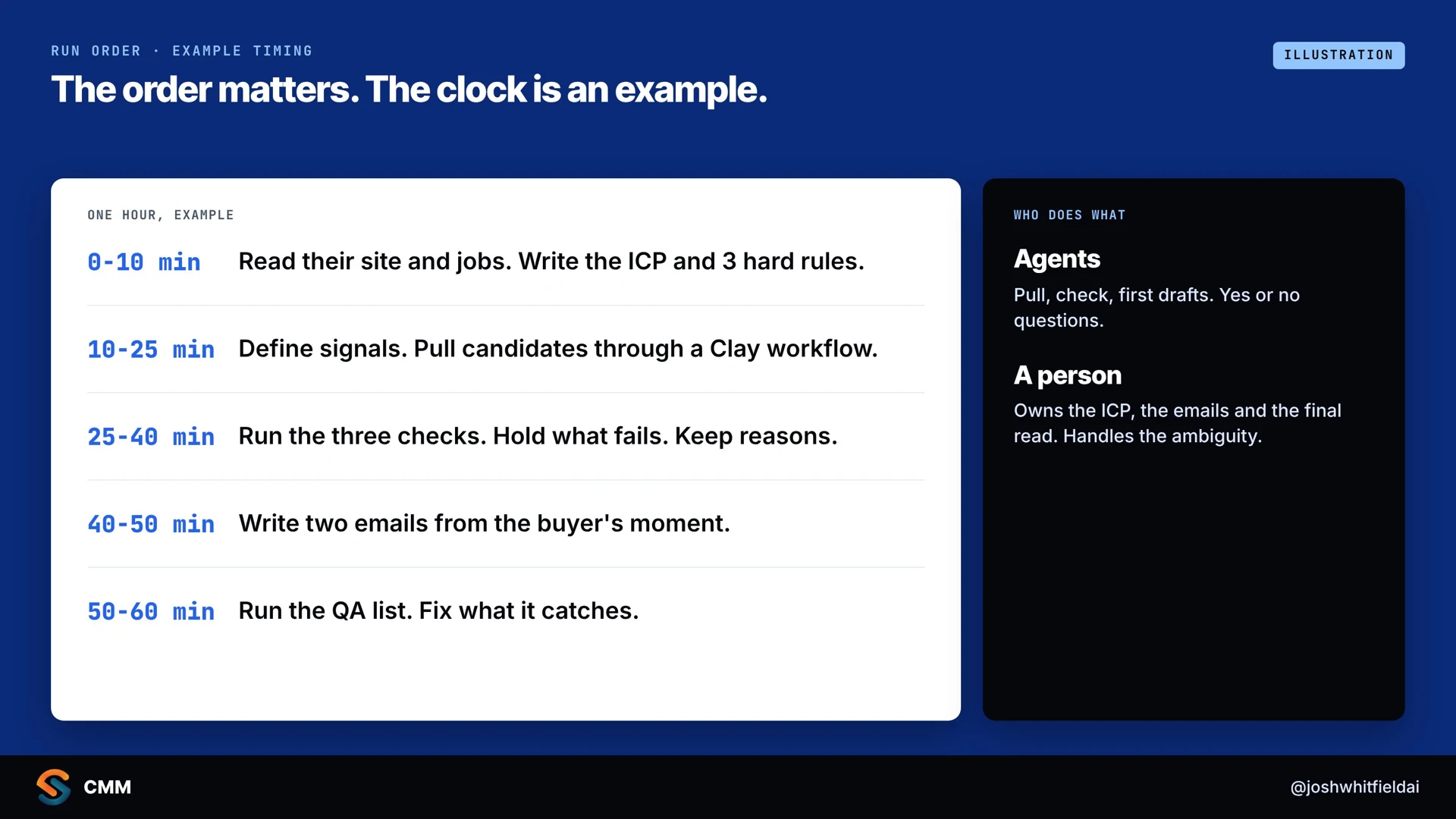
Here is the shape of the hour. These minutes are an example, not a benchmark. Your first pack will take longer. The point is the order, not the clock.
Minutes 0 to 10: read their site, their last posts and their job pages. Write the ICP paragraph and the three hard rules.
Minutes 10 to 25: define the signals and pull the candidate accounts through a Clay workflow.
Minutes 25 to 40: run the three checks. Hold what fails. Keep the reasons.
Minutes 40 to 50: write the two example emails from the buyer's moment, using one real row each.
Minutes 50 to 60: run the QA checklist and fix what it catches.
The agents do the pulling, the checking and the first drafts. A person owns the ICP paragraph, the example emails and the final read. Agents answer yes or no questions. People handle the ambiguity.
QA before the call
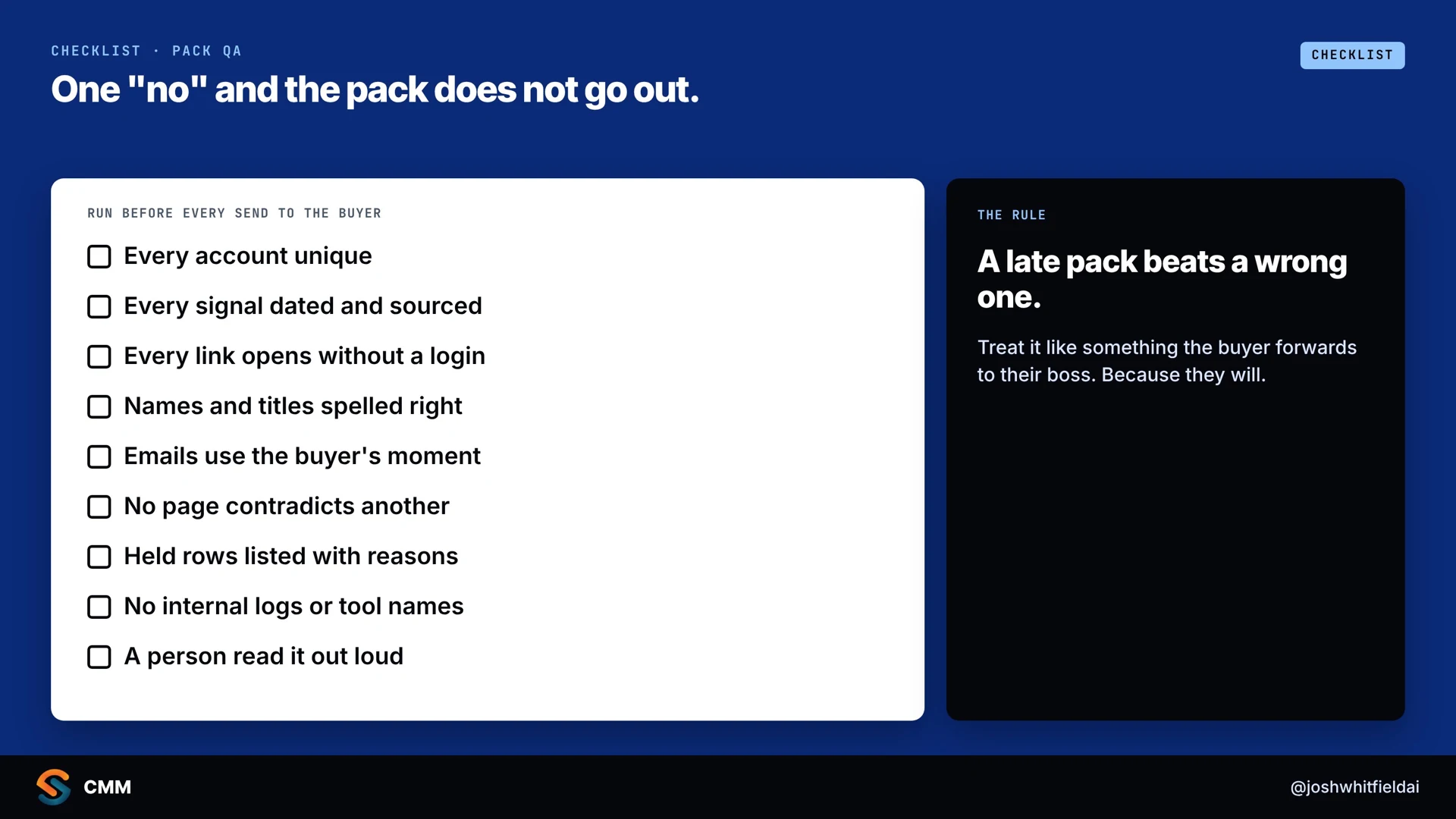
The pack goes to the buyer before the call. So it gets checked like something the buyer will forward to their boss. Run this list every time:
Rule: one "no" means the pack does not go out. Fix it or hold the pack. A late pack beats a wrong one.
Rule: reading it out loud catches what scanning doesn't. If a sentence sounds like an ad, rewrite it.
What you show live, what you send after
On the call, you screen-share the pack and walk the buyer through one account, start to finish: the signal, why it counts, the person, the email. Then you ask them to pick any account in the sample and tell you if it is wrong.
That question is the whole play. It hands them the job of finding your mistakes, and every correction they make is free ICP calibration.
After the call, you send the same pack as a sheet they can open and forward. Not a different, prettier version. The same thing, so what they saw is what they have.
Three rules:
Show one account deeply, not twenty shallowly.
Invite the correction. A buyer who fixes your ICP is a buyer who now owns part of it.
Send the identical pack after the call. If it changes between the call and the email, trust drops.
What stays out of the pack
The pack is buyer-facing proof. It is not an internal receipt. Keep them separate.
No run logs, workflow names or tool screenshots. The buyer doesn't need to see your plumbing, and your plumbing is not the pitch.
No numbers you can't show the source for. If you can't link it, don't claim it.
No claim about results you haven't earned for this buyer. A pack is a plan and a sample, not a promise.
No "built" presented as "sent." A built campaign is a draft. Say it is ready for approval, not live. Nothing goes out until a person on the buyer's side says go.
No account in the sample without a verified reason. Padding the sample makes the whole pack look padded.
Failure modes, with fixes
Failure: the sample list looks impressive and the emails are generic. Fix: cut the list to the rows with a real signal, and rewrite the emails around one of them.
Failure: the signal is six months old. Fix: add a freshness rule. Past your cutoff, the row is held.
Failure: the pack is great and the call turns into a capabilities Q and A anyway. Fix: lead with the pack in the first two minutes, before they ask anything.
Failure: the buyer finds a wrong account and the call goes cold. Fix: you wanted that. Say "good catch, that's a hard rule we missed," change the rule on the spot, and show the list update.
Failure: the pack takes four hours. Fix: cut sections, not checks. Shrink the sample to 10 accounts, keep all three checks.
Failure: an agent reports the pack as done because the file exists. Fix: done means the QA checklist passed and a person read it. A file existing is not a pass.
Start here
Do this once, this week, before your next call:
Pick one real prospect with a call on the calendar.
Write the ICP paragraph and three hard rules in ten minutes.
Find five accounts with a dated, public signal. Run the three checks on each. Hold what fails.
Write two emails from the buyer's moment.
Run the QA list. Send the pack the day before the call.
On the call, ask them to find the wrong account.
Your first pack will be rough. That's fine. The second takes half the time, and by the fifth you'll wonder why you ever opened a call with slides.
If you want a pack like this built and handed to your team, that's what we do at CMM. My DMs are open.
Article figures