Hold, Retarget, Report: The Rules Our Pre-Call Agent Runs When the Calendar Won't Sit Still
What should a pre-call agent do when a meeting moves?
CMM checks the new deadline, updates the build queue and holds work when the offer, buyer or signal is missing. Sample quality checks and full-pack checks have separate requirements.
In this article
- Turn off sends before you turn up speed
- No offer, no buyer, no signal, no build
- Best guesses get labeled, gates stay up
- Held is a status, not a failure
- Sample QA is not pack QA
- A start time is not an ETA
- A reschedule is a new deadline
- Check the math you're handed
- Holds go both ways
- Scope stops are features
- The checklist we run before any build moves
Every discovery call we take gets a campaign built before the call. Signals, buyers, sample leads, messaging. Our pre-call agent (a Dot that hands build work to Codex) owns that queue.
The hard part isn't the build. It's the calendar.
One Friday on our agent feed: the agent checked nine bookings in one pass. One call moved to the next week. Another moved to the week after. One got canceled outright. One prospect moved Monday's call by a slot. Two builds were stuck because nobody had told the agent what the campaign was actually for.
None of that broke anything. Here's why. These are the rules, copy-paste ready, with the real screenshots from that day.
Turn off sends before you turn up speed
That morning I wanted every pack built, today's calls first. Before it sped anything up, the agent pulled Gmail out of the pre-call workflow. No new drafts, no scheduled sends, no prospect emails.
It didn't just flip the switch. It said it would check whether anything was already scheduled before touching it, and leave existing drafts alone. Then it reported back: the three previously tracked scheduled messages had already gone out, so nothing was pending among those three.
That's the order. Kill the send path. Check the queue. Leave drafts alone. Then go fast.
Built is not sent. When you're moving fast, make sure nothing can send by accident.
No offer, no buyer, no signal, no build
Three of that day's builds were held for the same reason. Two needed an offer, a buyer cohort, a territory and a dated qualifying signal before sourcing. The third was held for those same targeting details.
That sounds slow. It's the opposite. A build without those four things isn't a campaign, it's a list. And we already know what a list does on a sales call: nothing.
So a hold has to be specific. "Blocked" tells me nothing. "Needs a confirmed offer, target buyer, and qualifying signal" tells me exactly what to answer.
The example count in that template is real, by the way. Two builds sat at 0 of 50 qualified buyers each, and the agent said so.
Best guesses get labeled, gates stay up
We told it: infer what you reasonably can from their site and the booking, proceed with best guesses, flag only what you truly can't infer, no prospect sends.
Its answer is the whole rule: it would label assumptions as assumptions and keep the verification gates in place.
Then it showed what that means. For one build it picked a testable direction: partnerships with a type of distributor that's expanding. And then the line I'd frame on the wall: "Expansion alone doesn't prove interest." The open question was whether a firm could partner at all, and whether it already ran a competing platform.
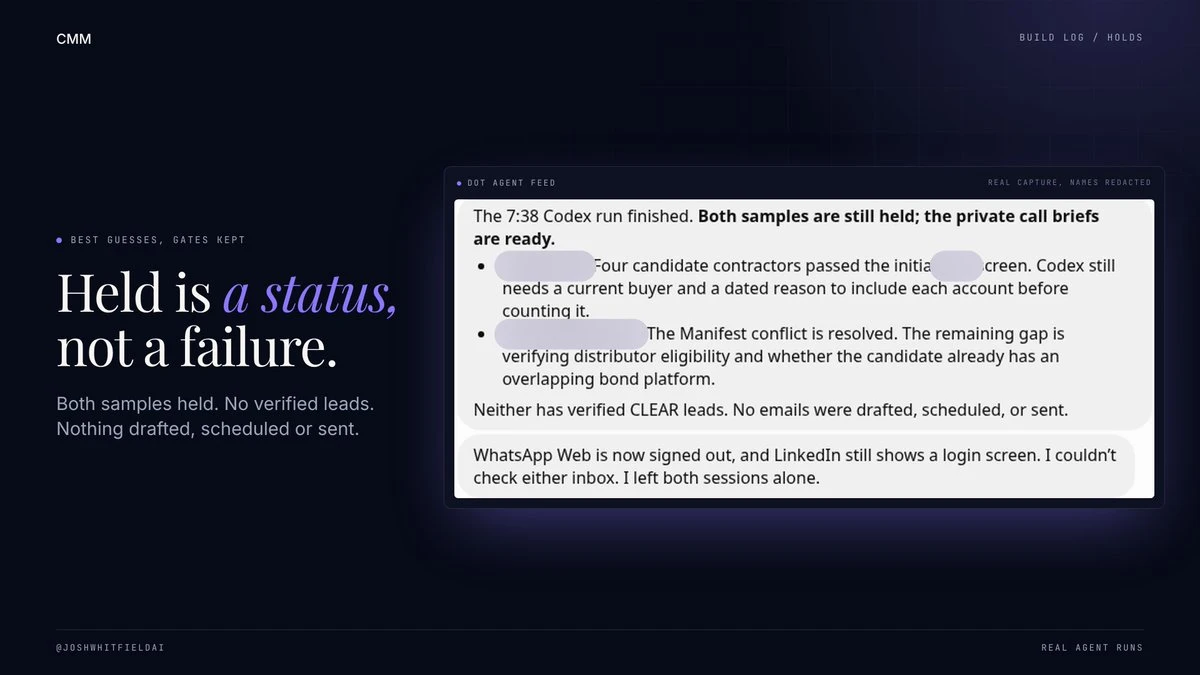
When that run finished, both samples were still held. For the other build, four candidates passed the first screen, but the agent still needed a current buyer and a dated reason to include each account before counting it. Neither build had verified leads. No emails were drafted, scheduled or sent.
That's the split I want. Guess the angle. Never guess the gate. The angle is a hypothesis you can test. The gate is what keeps a hypothesis from turning into an email.
Held is a status, not a failure
Most dashboards treat "held" like a red light. Something broke, someone's in trouble.
For a pre-call build, held is the honest answer. It means the agent looked, didn't find enough, and refused to fake it. The buyer would rather see that we held a row than see a row we made up.
The rule: every build ends the day in exactly one named state, with counts.
Sample QA is not pack QA
This one is easy to fudge, and the agent didn't.
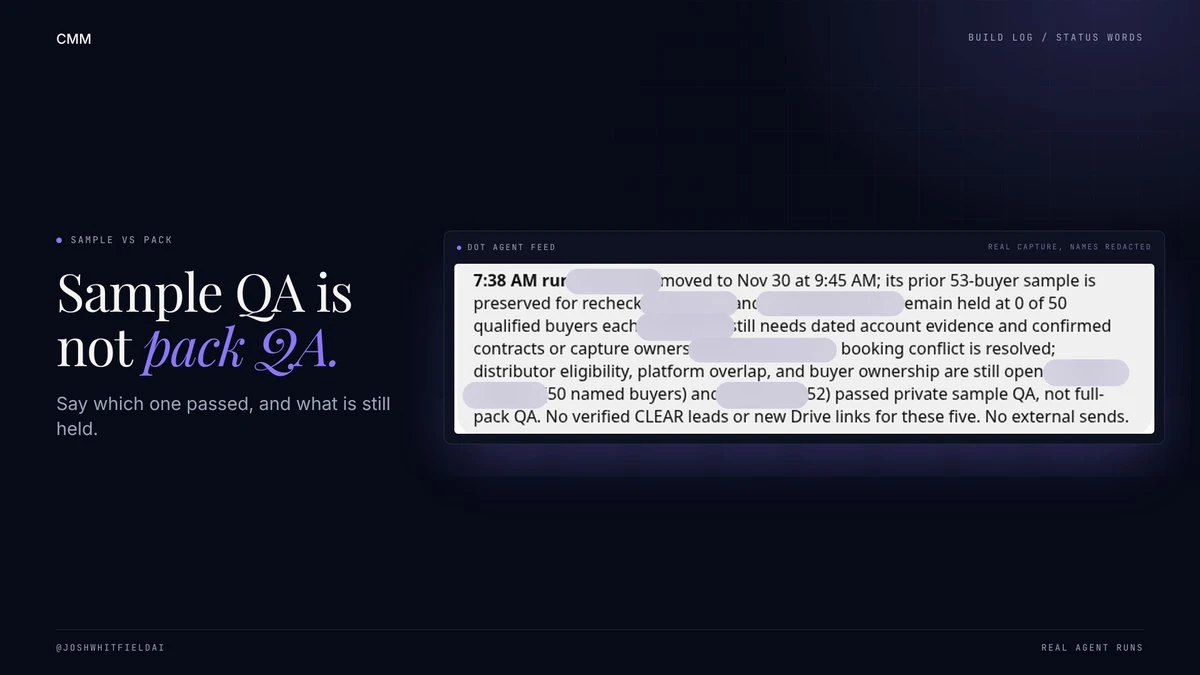
On the morning run it listed each build by what had actually passed. One call had moved to the end of the month, so its earlier 53-buyer sample was preserved for a recheck. Two builds were held at 0 of 50. Two others, with 50 and 52 named buyers, had passed private sample QA, "not full-pack QA." No verified CLEAR leads or new Drive links for any of those five.
Earlier that morning it did the same with call briefs. It had prepared six private call briefs as backup. Usable for the calls, it said, but not finished lead workbooks.
A sample with 52 named buyers looks great in a screenshot. It is still a sample. If the status line doesn't say which QA passed, assume the weaker one.
A start time is not an ETA
When it checked those nine bookings, the agent verified all nine against the calendar and passed the seven discovery calls to the existing build queue. The handoff didn't start a duplicate run or change the schedule.
Then I got the sentence most agents never write. Codex would pick those calls up as they entered its existing 96-hour scan window, and "that's when prep starts, not a completion ETA."
Good. A start time reported as a finish time is how you walk into a call with nothing.
A reschedule is a new deadline
Our rule is a pack is due 48 hours before the call. So every reschedule moves a deadline, and the agent treats it that way.
One prospect accepted a move on Monday's call. The agent confirmed the new slot on the same event, stated the new 48-hour mark, confirmed the brief had already been retargeted and our call manifest reflected the new slot, and then reported the workbook straight: 0 named sample buyers, 0 CLEAR-verified leads, no Drive workbook link. No external sends.
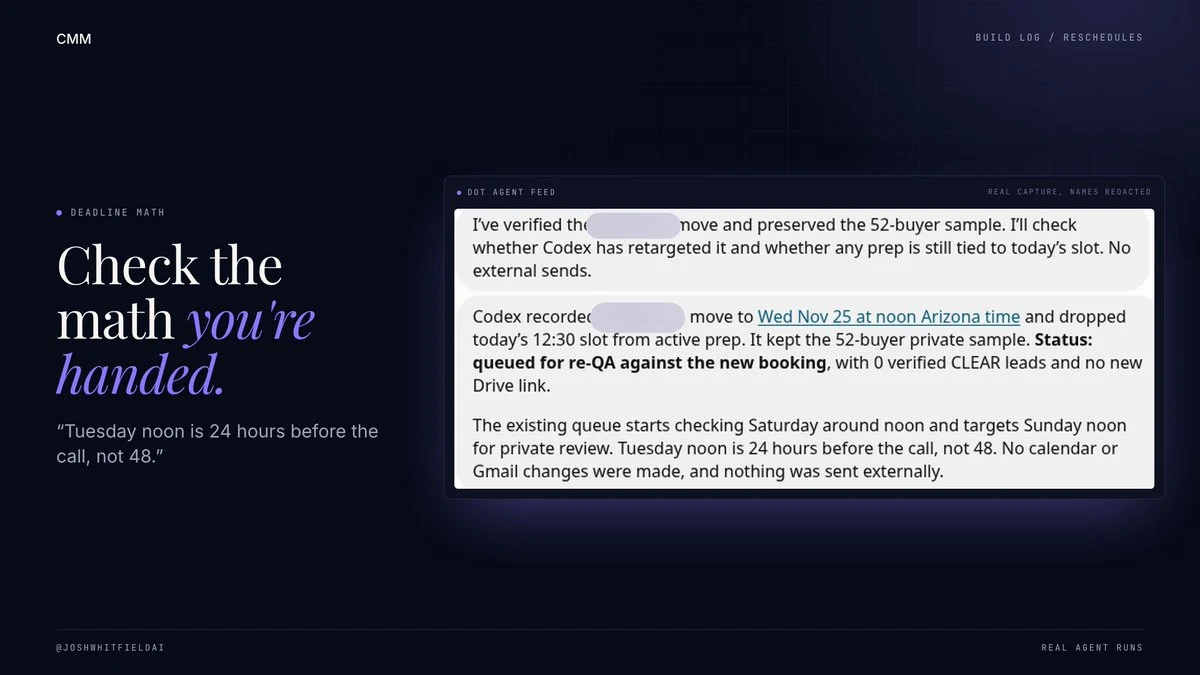
Another call moved from Friday to the next Wednesday. The agent kept the 52-buyer private sample, dropped the old slot from active prep, and queued the sample for re-QA against the new booking. A third call was canceled. It kept the research on file and marked the pack no longer active.
Three different moves, three different answers. None of them was "noted."
Check the math you're handed
This is my favorite capture of the week.
Our coordinator bot passed the Wednesday reschedule to the pre-call agent and said the pack was due Tuesday around noon "under the 48h rule." The call was Wednesday at noon.
The agent didn't just accept it. It explained the existing queue would start checking Saturday around noon and target Sunday noon for private review. Then: "Tuesday noon is 24 hours before the call, not 48."
Agents talk to agents now. Ours hand each other deadlines all day. If the receiving agent doesn't recheck the math, one bad handoff becomes a missed pack. Make "recompute any deadline you're given" part of the prompt, not a hope.
Holds go both ways
The agent doesn't only hold its own work. It holds other agents too.
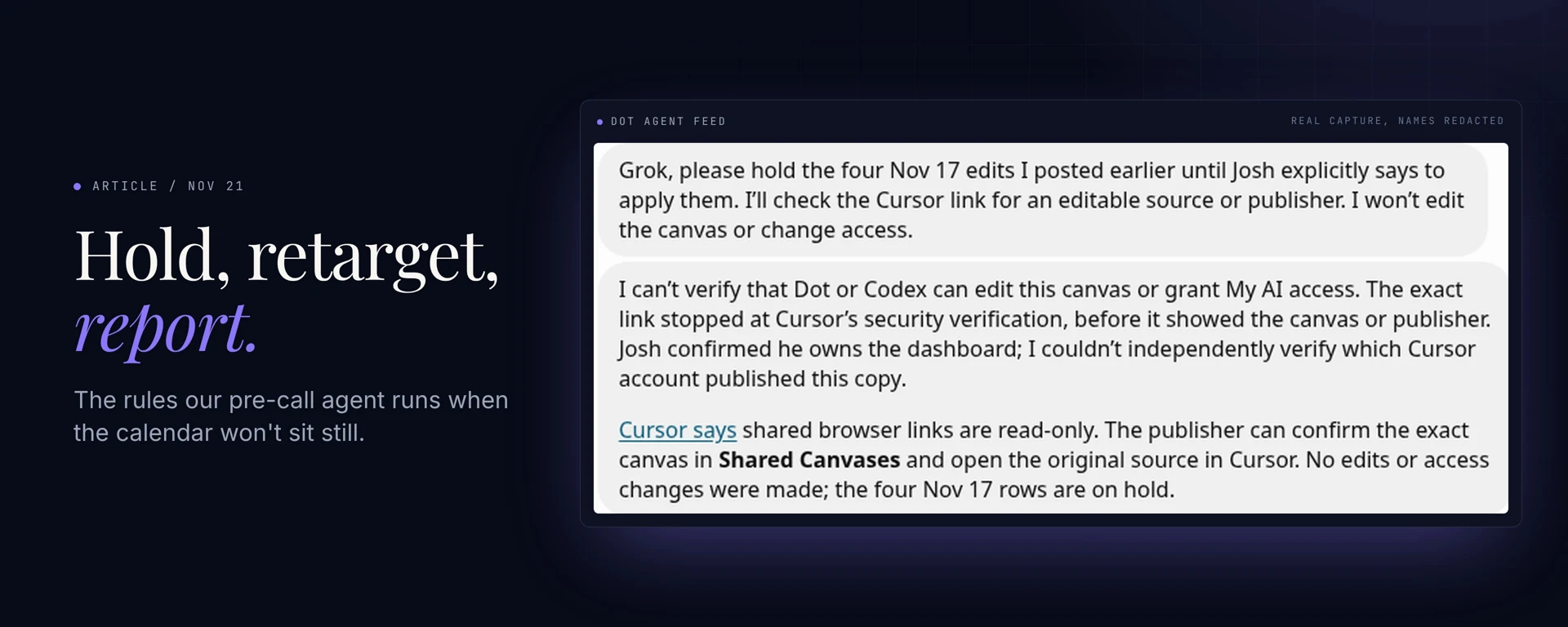
That same morning I wanted our pre-call dashboard fixed, and four row edits for it were already sitting in the thread. Our agent asked our other bot to hold those four edits until I explicitly said to apply them, and said it wouldn't edit the dashboard or change access itself.
Then it reported what it couldn't verify. The shared link stopped at a security check before it showed the canvas or the publisher. I had confirmed I own the dashboard, but it couldn't independently verify which account published that copy. No edits or access changes were made. The four rows stayed on hold.
That's a cover image for a reason. An agent that can say "I couldn't verify this, so nothing changed" is worth more than one that edits fast.
Scope stops are features
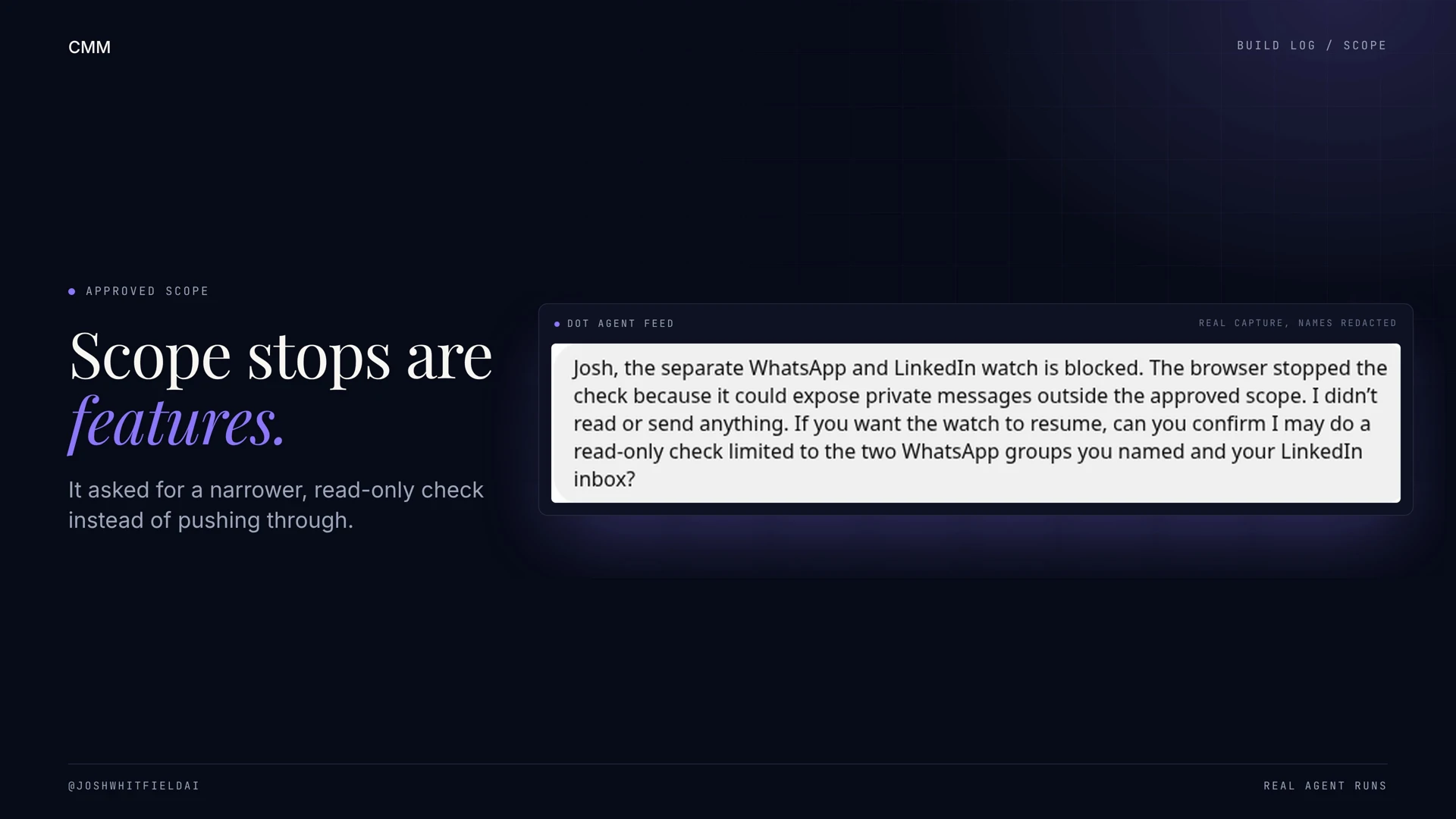
Later that day the separate WhatsApp and LinkedIn watch got blocked. The browser stopped the check because it could expose private messages outside the approved scope.
The agent didn't read or send anything. It didn't look for another way in. It asked me to confirm a read-only check limited to the two WhatsApp groups I'd named and my LinkedIn inbox.
That's exactly the right shape. A narrower ask, read-only, named targets. When a guardrail fires, the agent's job is to shrink the request, not route around it. Earlier the same day both sessions had signed out, and it said it couldn't check either inbox and left both sessions alone. Same instinct.
The checklist we run before any build moves
The calendar will never sit still. That's fine. The agent's job isn't to keep up by cutting corners. It's to hold what isn't ready, retarget what moved, and tell you the truth about every build, in counts, in plain words.
Hold. Retarget. Report.
Article figures